

Hire by Technology
SERVICES


Knowing about the top trends in digital banking allows you to prepare ahead of time, find the right developers with the right skills, and work on new features long before they become urgent.
These trends are usually indicative of a shift, preparing for future regulations and improving security, as well as changing user expectations.
Based on everything we have observed in the last few years in terms of what banks and fintechs are actually shipping, we have noted seven digital banking trends we think you should take note of in 2026:
Let’s look at what each trend encompasses and what each one means to build.
At Trio, we specialize in fintech app development. Our senior developers are at the forefront of the industry and can assist you with implementing current best practices and setting your application up to absorb future changes.
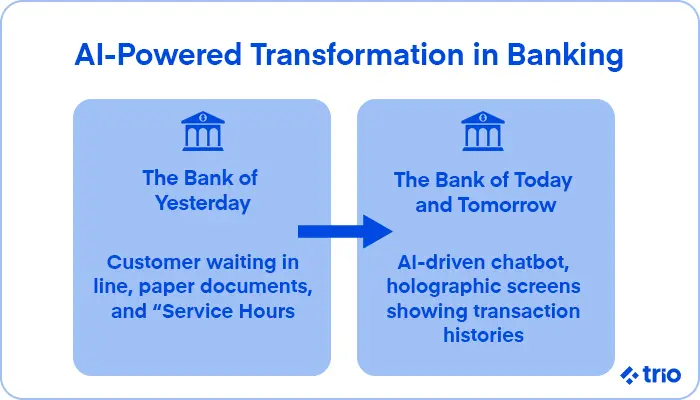
AI is not new by any means, but the AI conversation in banking has shifted meaningfully. Through 2024 and 2025, most bank-facing AI was assistive.
We helped companies build and integrate things like a chatbot answering questions or a recommendation engine surfacing a product.
Now, the more significant shift is toward AI that acts by initiating a transfer, adjusting a budget, flagging and resolving a billing dispute, or doing anything else on a customer's behalf rather than just advising them.
For an engineering team, the acting AI needs clear permission boundaries (what it's allowed to do without confirmation, and what it isn't), a genuine audit trail of every action taken and why, and a reliable way to roll back an action that turns out to be wrong.
In short, the interesting engineering problem is the guardrails around what an autonomous system is allowed to touch in a financial account.
Embedded finance refers to financial services built directly into non-financial platforms.
Examples like checkout financing on an e-commerce site, payroll advances inside a gig-work app, and savings tools inside a budgeting app all continue to grow as a distribution channel.
For a bank or fintech, this means a large share of the industry's growth now happens through an API a bank ships.
A partner platform's engineering team is going to be the one actually building against the API, which means documentation quality, sandbox realism, and error handling clarity are now product decisions with real revenue attached.
Open banking's early phase was mostly about account data: balances, transactions, read access.
Now, we are seeing the same API-first, consumer-permissioned model extended to a wider set of financial products (lending, insurance, and investments) under a broader "open finance" framing.
For US teams tracking this specifically, it's worth knowing that Section 1033's regulatory status has been genuinely unsettled through 2026, which makes the technical direction (FDX-standard, consumer-permissioned APIs) more durable to build toward than the exact compliance deadline.
Real-time and near-real-time payment rails keep expanding. What is important for fintech leaders is the continued move toward ISO 20022 as the messaging standard behind them.
Unlike older payment message formats, ISO 20022 carries rich, structured data alongside the payment itself, which means a B2B payment can arrive with enough embedded remittance information to reconcile automatically.
If your team is building payment or reconciliation features, this is a genuine architecture decision: systems built to actually use the structured data ISO 20022 carries get real automation value out of it, while systems that just parse it for the bare minimum fields needed to move money leave most of that value on the table.
Stablecoins have shifted toward something banks and payment companies are actively building settlement infrastructure around.
This connects directly to real regulatory activity. The US GENIUS Act, signed into law in 2025, established a framework for dollar-backed stablecoins specifically, and traditional financial institutions have been exploring stablecoin rails for cross-border and treasury use cases since.
The engineering implication is that stablecoin settlement is worth understanding even for teams with no current crypto exposure.
Financial super apps have been growing in popularity. Users are starting to expect more and more from a single app, providing increased motivation to companies to combine banking, payments, investing, insurance, and personal finance management.
Sometimes this can even stretch into shopping and lifestyle services too.
Alipay in China and Rappi in Latin America are just two examples that have been incredibly successful.
While we’ve seen a lot of companies questioning if this is what customers really want, or if it’s just a business ambition, the realistic middle ground is that consolidation genuinely helps in specific categories (seeing all accounts and spending in one view is a clear win).
Bolting on unrelated services purely to chase the super app label tends to add complexity without adding much real usage.
For engineering teams, the honest build lesson is that a super app isn't really one product. In most cases, it's several products sharing a shell.
In terms of architecture, we’ve seen a shift away from monolithic, decades-old banking cores toward a modular setup built from independent, swappable components connected through APIs.
In some cases, you can think of this more as assembling a bank's technology like building blocks rather than pouring one fixed foundation.
A bank that wants to add a new lending product, swap a fraud vendor, or launch a super app-style consolidated view doesn't want that to mean touching a core system that's been running unchanged for twenty years.
For a team evaluating this shift, the real engineering question is how to sequence the migration away from a legacy core without a multi-year, high-risk rebuild that stalls everything else the business needs shipped in the meantime.
Each one of these trends shows up as a real build decision:
Building against any of these trends well requires engineers who've actually worked inside regulated financial systems before.
Screening directly for this takes time and resources. But, in most cases, it is worthwhile, as general backend developers can create gaps that require expensive fixes later.
Trio places fintech engineers with real production experience in exactly these areas: payments infrastructure, open banking APIs, and regulated system design.