
Hire by Technology
SERVICES


The fintech market is projected to grow to nearly $900 billion by 2030, and considering the massive portion of regular app users that use their phones as their primary device, mobile is likely going to be a massive contributor to that growth.
However, if you are going to benefit from that growth, you need to create applications that offer smooth user interfaces and that handle user data securely. Any perceived breach in trust or unprofessionalism might encourage users to turn elsewhere.
In short, a successful fintech app balances user expectations, real regulatory demands, and a pace of change most other software categories don't have to contend with.
Let’s look at the step-by-step process of fintech app development. If you need developers to ensure that your app is compliant and meets industry standards, we can assist.
Fintech app development, as the name suggests, means building mobile applications that deliver financial services. Some of the most common examples include mobile banking, payment apps, personal finance tools, lending platforms, insurance products, or crypto exchanges.
Many of these apps function as modern interfaces sitting on top of legacy financial infrastructure underneath, which is part of what makes the engineering work more involved than a typical consumer app.
For a startup in the finance sector, mobile-first development costs less than standing up a traditional financial services operation. Focusing on building a fintech mobile app first greatly lowers the barrier to disrupting an established market.
In some cases, it's also easier to iterate quickly and test with real users, especially starting from a focused MVP rather than trying to launch a full-featured product on day one.
For an enterprise, a fintech app is a way to keep pace with the market, modernizing how existing services get delivered while adding new ones, while taking advantage of the institutional trust that you already have.
There are some great examples of successful fintech apps on the market.
While there is definitely a case for super apps, notice how each of these succeeded by specializing deeply in one or two things rather than launching broadly. Expansion can happen later, as users request additional features.
Open banking, or letting third-party apps access financial data with consent, has expanded what banks can offer while raising the bar on security and data handling.
Embedded finance keeps growing too, with financial services showing up inside platforms that aren't financial companies at all. This is the same pattern behind Klarna, which now shows up inside most ordinary online checkouts.
We’re also seeing a shift in previously cemented success patterns.
Traditional branch banking keeps losing ground to digital-first models. Outside of simply being convenient, the success of neobanks and similar products is driven by user demand for transparency, simplicity, and lower cost as much as by the underlying technology shift.
On the more experimental side of things, decentralized finance and blockchain-based tools remain an active area. We’re watching these trends very carefully to see where they land and are helping our clients prepare for changes going forward.
While the exact development process depends on your specific app, there is a general process you can follow to ensure nothing falls through the cracks.
Solving a real problem well beats covering broad ground badly. It also gives you something to market to clients.
Digital banking, payments, budgeting, robo-advisory, P2P lending, insurtech, regtech, and crypto are all viable directions.
Regardless of what the actual direction is, picking one deliberately, based on real market opportunity, shapes everything that follows.
This is where fintech development genuinely diverges from building a normal app.
Requirements like GDPR, PSD2, AML, and PCI DSS apply from day one, and a fintech-experienced partner can flag obligations a team might not think to check for until they've already scaled them.
KYC processes, secure data handling, and consent management for third-party integrations all need real design attention. Getting this wrong is far more expensive to fix later than simply setting yourself up for success from the start.
Issues can also mean serious fines or lost user trust that's hard to earn back.
Essentially any way you can think of to monetize is fair game, but keep in mind that while transaction fees work for traditional banking and trading products, they can create a real barrier to adoption.
From what we have seen, subscriptions and tiered plans suit budgeting tools well.
Premium feature upselling, referral programs, and (handled transparently, with real consent) data monetization are all viable alternatives depending on the product.
If your product is in the B2B sector, then API access, or charging other companies to build on a platform, is its own monetization path worth considering.
Building everything at once isn't realistic for most teams, especially if you are just starting out. Fortunately, it isn't necessary either.
A focused MVP with the most important features, typically a clean UI with real-time dashboards, secure verification, solid encryption, and some degree of AI-driven personalization, ships faster and gets real user feedback sooner than a fully-loaded version ever could.
This has the added benefit of giving you the ability to adjust your approach and minimize your overall risk.
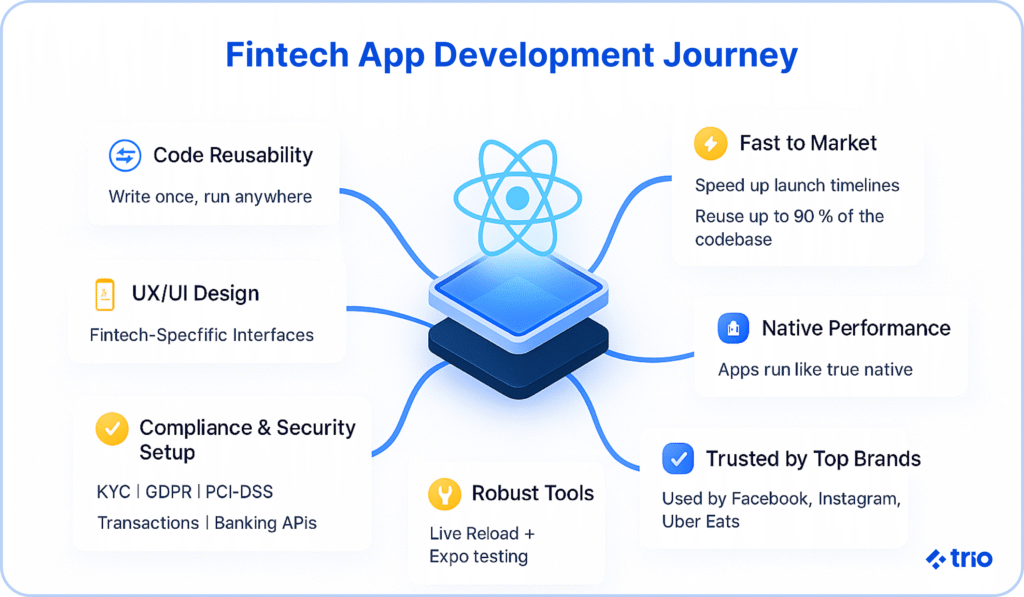
JavaScript and Python are some of the most common languages we see used in fintech development, enabling frameworks like React Native, Flutter, and SwiftUI on the frontend, and Node.js, Django, or Ruby on Rails on the backend.
Cloud infrastructure is standard as well, and typically runs on AWS or Google Cloud, containerized with Docker and Kubernetes.
Third-party APIs, already built to be compliant, are often the more practical starting point over building payment or identity infrastructure from scratch.
Once you have more funds available, you can consider replacing API services to decrease vendor risk.
Hiring each developer individually is possible but resource-intensive.
You will have to move through an extensive process that involves portfolio reviews, interviews, and onboarding. The real risk of a costly mis-hire all adds up.
Staff augmentation through an experienced partner like Trio compresses this considerably, connecting a team with developers who already have relevant fintech project experience, without the commitment of a full-time hire whose future workload isn't guaranteed yet.
Our developers have commented that Agile methodologies suit fintech development well, given how much requirements tend to shift as compliance research and user feedback both surface new information.
Automated testing (simulated user interaction) paired with real beta testers gives more complete coverage than either approach alone. Both are pretty much considered to be industry standards at this point.
Reliability, low latency, and error-free transaction handling are also critical, and app store compliance requirements need attention before submission.
Once your app is live, pay attention to reviews, in-app feedback, and analytics. These can tell you what to build next.
A/B testing tends to work better than intuition alone for fintech UX specifically, since financial decision-making under pressure doesn't always behave the way product instinct predicts.
Technical debt accumulates fast in a space that changes as quickly as fintech does, and staying competitive means continuously revisiting existing features.
AI and automation increasingly handle routine tasks and personalization work that would otherwise consume real engineering time.
If you are planning for expansion into new regions, you will also need to plan for different regulatory regimes and currencies.
Continued attention to accessibility, screen readers, and alternative input methods keeps a product usable for the widest possible audience as it grows.
One of the best ways to ensure success is to look for a partner with genuine, provable experience in a comparable product.
When evaluating a potential company, real case studies and references matter a great deal, since fintech-specific judgment is hard to fake convincingly in a sales conversation.
At Trio, our developers have worked on several high-stakes fintech projects. To see if they are the right fit for you, request a consult.