

Hire by Technology
SERVICES



June 1, 2026, was the date both GitHub Copilot and Cursor rebuilt how they bill.
GitHub's own community discussion thread filled up fast with developers describing agentic sessions that burned through a meaningful chunk of a monthly allotment in a single sitting.
Cursor's update, by contrast, went a little more unnoticed, in part because Cursor estimates it actually lowers costs for the large majority of existing Teams customers.
The two changes aren't equivalent. Copilot moved from a flat, generous model to a token-metered credit system where heavy agentic use can burn through a month's budget faster than most teams expect.
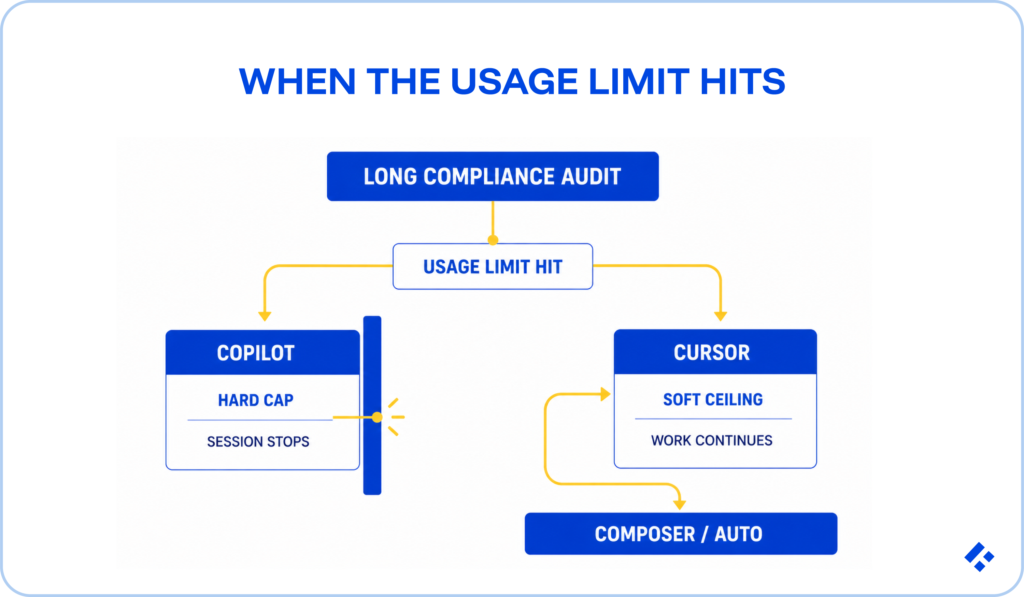
Cursor restructured its Teams plan to separate first-party usage (Composer 2.5, Auto) from third-party usage (Claude, GPT-5, Gemini), and gave teams a soft ceiling on the third-party side instead of a hard stop.
For a fintech engineering team, where compliance code review runs on autopilot, and audit sessions stretch across hours, the difference shows up in the budget and in the middle of the workday.
Let’s walk through what changed at each tool, why it lands differently on fintech workloads specifically, and what the updated recommendation looks like depending on your team's profile.
If you need skilled fintech developers who are not only capable of using these tools to increase their coding productivity but who have the production experience to pick up on errors that may cause security or compliance issues, we can assist.
GitHub replaced its flat Premium Request Unit (PRU) model with GitHub AI Credits on June 1, 2026. The mechanics, which we have confirmed straight from GitHub's own blog and documentation:
A few other things shipped alongside the billing switch.
Copilot code review moved onto an agentic architecture that runs on GitHub Actions, so as of June 1, reviewing a pull request with Copilot now consumes GitHub Actions minutes in addition to AI Credits.
User-level budget controls also became generally available for organizations and enterprises. Practically, this means that admins can cap spend per person rather than only at the org level.
Unfortunately, it seems that annual plans are being phased out, with existing annual subscribers keeping their current terms until expiration, then moving to monthly.
Copilot Max also launched as a new upgrade tier for existing Pro and Pro+ subscribers who need higher ceilings.
New sign-ups for the individual plans paused briefly around launch and reopened within a couple of weeks.
From what we have observed, it seems that the community reaction to the billing change itself was mostly negative.
There is a lot of this sentiment visible directly in GitHub's own community discussion thread, where developers described burning through a large share of a monthly credit allotment in a single working session.
Related Reading: Claude Code vs Cursor for Fintech Engineering Teams
Three implications from the Copilot changes hit fintech engineering teams harder than they hit a typical software team.
Plenty of fintech teams that we have worked with run Copilot code review as a compliance gate, an automated first pass on every change to payment services, KYC pipelines, or ledger infrastructure.
Starting June 1, each of those reviews now draws from both the AI Credits pool and the GitHub Actions minutes budget.
If your team is, for example, pushing daily commits to payment services across a ten-engineer squad, you are now paying two meters for something that used to cost one.
A heavy agentic pass, like auditing a KYC pipeline for state-machine gaps, or walking through payment reconciliation logic across several services, can now plausibly run into the tens of dollars in credits before it's done.
Copilot Pro's entire monthly allotment sits at $15.
That means that one long audit session can exceed your entire allotment in a single sitting.
Business and Enterprise plans have more headroom, but the promotional boost that's cushioning that headroom right now expires at the end of August.
Flex allotment is variable and can change as the economics shift. Base credits are the only part that GitHub committed to holding steady.
For a 50-engineer fintech team on Copilot Enterprise, the drop from $70/user to $39/user works out to roughly $1,550 less in included monthly credits, org-wide, at the same per-seat price.
If your teams rarely hit their ceiling, they may not notice. Teams running daily automated compliance review and long, agentic sessions at scale almost certainly will.
Cursor restructured its Teams plan in June 2026, effective immediately for new customers and on the first billing cycle after July 1, 2026, for renewing ones.
The changes lower costs for around 90% of existing Teams customers.
The core architectural change is that every seat now carries two separate usage pools instead of one shared bucket.
New seat tiers came with the update.
Standard stays at $40/user/month (or $32 annual) with meaningfully more usage under the new two-pool structure. Premium launches at $120/user/month (or $96 annual), built for the heaviest agent users, five times the included usage of Standard for three times the price.
A few other changes shipped in the same window.
Composer 2.5, Cursor's in-house coding model, scores 79.8% on SWE-Bench Multilingual, close behind Claude Opus 4.7's 80.5%, while running at roughly one-tenth Opus 4.7's per-token cost.
Cursor's Bugbot code review got faster and cheaper as a result. Response time dropped from around 5 minutes to about 90 seconds, and Cursor reports 10% more bugs found at 22% lower cost.
They also rebuilt their spend alerting so admins can set dollar-threshold notifications through Slack or email before a bill surprises anyone, launched a Pro+ tier at $60/month for individuals, and are offering roughly 20% off across paid tiers on annual billing.
Like with GitHub Copilot, there are three specific ways that these changes are going to impact the fintech teams going forward.
It’s not uncommon for a fintech engineer to be halfway through a KYC pipeline audit when the Third-Party API pool runs out.
Cursor routes that session to Composer/Auto rather than stopping it. Copilot's hard cap doesn't offer that option; hitting it ends the session outright.
At roughly a tenth of Opus 4.7's per-token cost with benchmark scores in the same neighborhood, Composer 2.5 is the cost-rational choice for everyday feature work.
It’s a valid option for things like extending a KYC form, adding a fee calculation field, and writing a reconciliation query.
This allows you to save the Third-Party pool and Claude's specific reasoning strengths for the tasks that genuinely need them.
An engineer who regularly runs multi-hour agent sessions for compliance audits or high-volume PR review batches is the intended Premium user, five times the usage for three times the cost.
For most fintech teams, that's two or three seats (a compliance lead, a payments lead), with everyone else fine on Standard.
| Dimension | GitHub Copilot (post-June 2026) | Cursor (post-June 2026) |
| Compliance PR review cost | Higher, code review now doubles the meters against both AI Credits and Actions minutes | Standard, Bugbot runs on Composer 2.5, with a roughly 90-second response, 22% lower cost than before |
| Agentic compliance audit spend | Hard cap, Pro's entire allotment is $15; one heavy session can exceed it | Soft ceiling, falls back to Composer/Auto rather than cutting off when the Third-Party pool empties |
| Budget predictability | Lower near-term, hard cap plus a September promo cliff that needs active planning | Higher, two-pool structure plus rebuilt dollar-threshold spend alerts |
| Enterprise usage pooling | Yes, Copilot Enterprise pools credits across the whole org | Yes, Cursor Enterprise pools usage; Teams runs per-seat pools instead |
| IP indemnity | Yes, a genuine Copilot advantage, relevant for fintechs approaching M&A or IPO | Not offered |
| Native platform integration | Deep, PR review, Issues, Actions, and GHES are all native | Third-party, by comparison, though the strongest option for teams not tied to GitHub's workflow |
| Model diversity | Multi-model within the subscription (Claude, GPT-5, Gemini) | Multi-model too, with Composer 2.5 as a cost-optimized first-party default |
| Per-seat pricing (team tiers) | $19/user (Business) or $39/user (Enterprise) | $40/user (Standard) or $120/user (Premium) |
| What's actually new in June 2026 | The credit system itself, the double-meter on code review, the September cliff | The two-pool split, the Premium seat, and Composer 2.5's cost-performance jump |
For any enterprise fintech team signing a tooling commitment right now, the flex-credit expiry at the end of August is incredibly important to consider.
GitHub has committed to keeping base credits fixed to price, so anyone on the Enterprise plan, for example, will always include $39/user in base credits.
The flex portion (the extra $31/user Enterprise is getting through the end of August) is explicitly described as variable and subject to change.
The math to run:
For a 50-engineer fintech team on Copilot Enterprise, that's roughly $3,500 in monthly credits today, falling to about $1,950 after the cliff, at the exact same per-seat price throughout.
We recommend that you build your team's cost model on the post-cliff $39/user baseline, not the promotional $70/user number.
If $39/user genuinely doesn't cover your typical usage, budget for overages now or take a hard look at whether Cursor, or a flat-subscription tool like Claude Code, fits your workload better.
The June 2026 billing changes turned AI coding tool governance into an actual engineering responsibility.
Setting user-level budgets, modeling the September cliff, routing compliance audit work to the right tool and tier, tracking cost per compliance review instead of just cost per seat, are all FinOps and engineering tasks now.
Trio places pre-vetted LATAM fintech engineers who handle AI tool governance as part of the job.
That means engineers who understand both the billing mechanics, credit pools, double-metering, fallback routing, and the compliance workflows actually driving the cost: compliance PR review, KYC audit agents, payment system review at scale.