

Hire by Technology
SERVICES



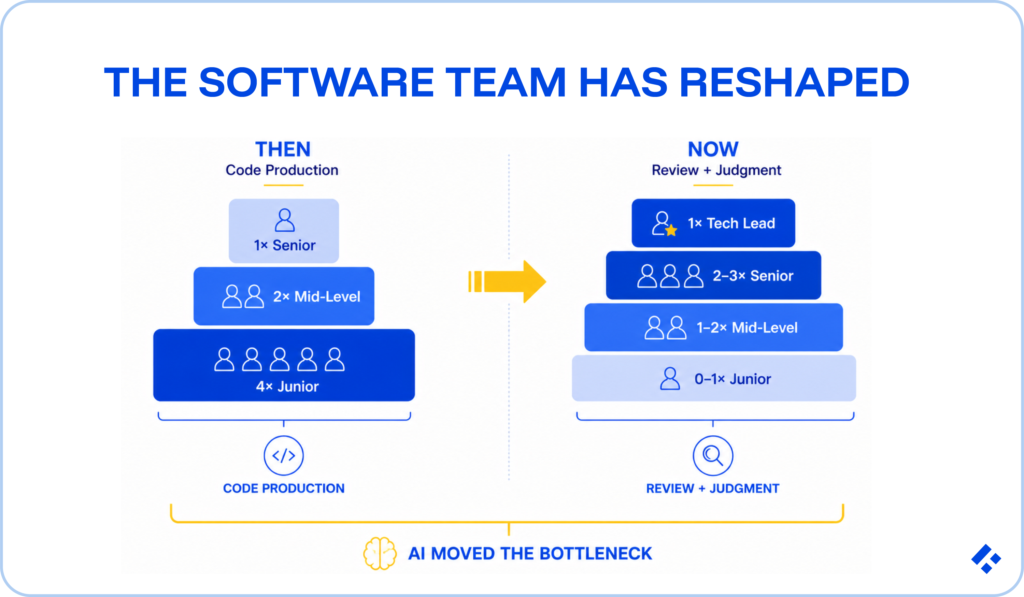
The standard software team used to include something like one tech lead, a few mid-levels, some juniors, and a QA person. This structure was designed around a bottleneck that has since moved, and likely isn’t the best fit in industries like fintech.
Thanks to the fact that AI can now write the boilerplate, the constraint becomes review, integration, and architectural judgment.
The team that fits 2026 is smaller at the bottom, heavier at the top, and more expensive per head.
Let’s look at everything you need to know about choosing the right team for custom software development, including why a more senior-heavy approach has become standard in industries like fintech.
For experienced developers who have worked on production financial applications before, we can assist.
In the past, standard teams used to be made up of a tech lead or senior owning architecture, a few mid-level and junior developers doing the bulk of the building, a product manager, a QA person, and maybe a designer.
This was the right approach when typing was the actual constraint. However, these days, the work that used to take up the majority of a developer’s time has now been automated: the boilerplate, the scaffolding, the first draft of tests, and the glue code between systems.
In short, the bottleneck moved from producing code to verifying it and deciding what should exist in the first place.
Entry-level job postings have reportedly fallen sharply, but postings and actual employment aren't the same thing.
From what we have observed, it seems the market is reshaping: smaller at the entry level, heavier with seniors, with review, integration, and system design increasingly treated as the core work rather than overhead layered on top of it.
| Role | What They Own | When You Need One | Notes |
| Tech lead | Architecture, technical direction, review standards | Day one, always | The one role you can't substitute or outsource judgment on |
| Senior engineers | Feature ownership end-to-end, review of AI-generated and junior work | Day one, and more of them than the old ratio suggested | The 2026 center of gravity |
| Mid-level engineers | Delivery under direction, growing into ownership | From roughly 4 people up | Still the workhorse; the squeeze is below them, not here |
| Junior engineers | Supervised delivery, increasingly review and testing of generated code | Deliberately, for pipeline reasons | See the honest note below |
| Product manager/owner | What gets built and why | Day one unless a founder holds it | Under-hired on outsourced builds |
| Designer | Interface and interaction | Any customer-facing product | Often part-time or shared |
| QA/quality engineer | Coverage strategy, release judgment | From roughly 5 engineers up | Embedded ratios around 1:8 are a commonly cited 2026 pattern, with a small central function owning tooling and standards |
| DevOps/platform | Pipelines, environments, observability | From roughly 6 engineers, earlier if regulated | Frequently shared across squads |
| Data engineer | Pipelines, warehouse, data quality | When the product's value is data | Distinct from ML specifically |
The product role is the most commonly missing one on outsourced builds specifically.
We have seen a lot of teams hire engineering capacity and keep product ownership internally, then under-resource it, and the engineers end up stalling while waiting for decisions.
The old default, one senior leading four to six juniors, was built on the assumption that junior output was cheap and additive. When AI produces the first draft of most routine work, the value shifts decisively toward whoever can judge whether that draft is actually correct.
These days, you can assume that a six-person build team runs roughly one tech lead, two to three seniors, one to two mid-levels, and at most one junior, with QA and platform shared or embedded rather than dedicated.
Experienced engineers are the scarcest and most expensive people in the US market right now, and in niches like fintech a senior hire commonly runs well north of $200,000 all-in, adding up quickly.
What now allows companies to save money is geography.
A senior-heavy team is genuinely viable at nearshore rates in a way it simply isn't at US rates, and timezone overlap between regions like LATAM and the US allows for real-time reviews.
If the industry stops hiring juniors, it stops producing seniors. The path from junior to mid to senior takes years of genuinely supervised work.
In areas like fintech, this experience is essential to develop a thorough understanding of how to code around regulatory frameworks.
We have noticed that some companies, like IBM, have reportedly moved in the opposite direction.
These companies are restructuring the role itself so juniors spend less time on routine coding and more on customer interaction, with AI-output review built directly into how the role works.
If your team is optimizing for 12 to 18 months of runway, an AI-augmented senior team is a rational, defensible choice. But if a team expects to be running this system in five years, hiring no juniors at all means paying full market rate for every seniority increment indefinitely.
To prevent this, we recommend that you have at least one junior per squad, paired deliberately, with real review time budgeted for it rather than assumed to happen for free.
A financial product needs roles and capacity that a generic product simply doesn't.
Essentially, a regulated build has a genuinely higher floor than a generic one. The five-person team that could ship a straightforward B2B SaaS MVP is often a seven-person team once the product actually moves money.
From what we have seen, four engineers seem to be the absolute minimum. The real constraint at that size is bus factor.
Around six to eight developers, coordination cost becomes visible enough to need explicit ownership boundaries rather than informal coordination.
Above that, we have found that splitting tends to beat growing further. Two squads with clearly separated surfaces reliably outperform one team.
Just remember that, while AI changed what a developer's day looks like, it didn't repeal Brooks's Law. Adding people to a project that's already running late still tends to make it later.
All internal only really makes sense when the product genuinely is the company. In these cases, the accumulated knowledge has to stay in-house permanently.
In most other cases, internal only isn’t really worthwhile since it's the slowest and most expensive path to assemble. Senior roles alone can take months to fill directly.
Internal core plus augmented engineers is the most common working shape we come across. In this configuration, a company keeps the tech lead and product ownership internally, while augmented senior engineers add real delivery capacity.
You are only able to add the augmented engineers so effectively because you have the internal engineering leadership capable of directing the work day-to-day.
A dedicated team fits when a company needs a full workstream owned end-to-end and doesn't have the internal leadership bandwidth to direct individual engineers closely.
Project outsourcing suits a defined build with a genuinely defined end date, not a product that's expected to keep evolving indefinitely afterward.
Overall, we recommend that you decide the shape of your team first, and then consider sourcing.
Teams that pick a sourcing model before deciding what shape the work actually needs usually end up with whatever team that model happens to produce, rather than the team the product genuinely needs.
At Trio, we have the experience to be able to advise you and connect you with developers. Our fintech specialists have guaranteed production experience, so they can contribute effectively from the start, regardless of the hiring model.