

Hire by Technology
SERVICES



Offshore development rates in 2026 range from $15-40/hr in South Asia, $25-70/hr in Eastern Europe, and $22-80/hr in LATAM, against $100-250/hr in the US.
For fintech-specific roles that involve payments, KYC/AML, ledger, and reconciliation, there is a 20-30% premium above these baselines. This is largely because regulated financial engineering draws from a narrower talent pool.
Pricing the role like a general software development one will put your budget behind from the start. This guide provides all the information you need to budget and make decisions, providing current offshore development rates by role.
To get an accurate idea of the cost of specific skill sets and to hire those developers without months of sourcing and vetting, reach out.
| Region | Junior | Mid | Senior | Tech lead/principal |
| LATAM | $22-35/hr | $35-58/hr | $65-80/hr | $85-140/hr |
| Eastern Europe | $25-40/hr | $35-55/hr | $55-70/hr | $75-120/hr |
| South Asia | $15-25/hr | $22-32/hr | $30-40/hr | $45-70/hr |
| US domestic | $65-95/hr | $95-140/hr | $140-200/hr | $200-250+/hr |
LATAM sits roughly 50-70% below US domestic rates.
Eastern Europe averages somewhere around $37/hr blended across seniority. South Asia carries the cheapest headline rate but, in practice, it is often the most expensive due to timezone friction that results from being 10.5 to 13.5 hours from the US Eastern timezone.
A "$45/hr LATAM developer" could be a mid-level React engineer building marketing pages, or a senior engineer who's already shipped a Fedwire ISO 20022 migration.
Across a dataset of more than 12,500 LATAM professionals (Howdy, 2026), fintech domain experience commands a real premium above baseline for the same seniority level, with AI/ML and DevOps/SRE roles carrying smaller but still meaningful premiums of their own.
That premium is a scarcity signal.
The pool of engineers who have genuinely built a double-entry ledger, wired up an enhanced due diligence escalation path, or handled a live Fedwire cutover is small, and demand is growing.
Some teams that we have worked with previously tried to hire a "senior backend engineer" at $58/hr to build a reconciliation service, only to discover months later that the engineers did not have the industry knowledge required to do so securely and compliantly.
Related Reading: Fintech Outsourcing Cost Guide: What it Actually Costs to Build a Fintech Engineering Team
Let’s take a look at some different offshore development rates for different roles. We will use LATAM as our offshore example due to the convenient time zone overlap with most of the US, and the region’s popularity in fintech specifically.
| Role | LATAM mid | LATAM senior | US senior | Premium vs. baseline |
| Frontend engineer | $35-50/hr | $55-68/hr | $130-170/hr | Baseline |
| Backend engineer (general) | $38-55/hr | $60-72/hr | $140-180/hr | Baseline |
| Full-stack engineer | $40-56/hr | $62-75/hr | $140-185/hr | +0-5% |
| QA / automation engineer | $30-45/hr | $50-62/hr | $110-150/hr | Baseline |
| DevOps / SRE (fintech) | $45-62/hr | $70-85/hr | $155-200/hr | +10-12% |
| Fintech data engineer | $45-62/hr | $70-85/hr | $150-195/hr | +12-18% |
| Security engineer (fintech) | $50-68/hr | $75-92/hr | $165-210/hr | +18-25% |
| AI/ML engineer (fintech) | $50-70/hr | $78-95/hr | $170-230/hr | +15-25% |
| KYC/AML engineer | $48-66/hr | $75-90/hr | $160-200/hr | +20-25% |
| Ledger/reconciliation engineer | $50-68/hr | $78-95/hr | $165-215/hr | +22-30% |
| Payment engineer (rail-specific) | $52-72/hr | $82-100/hr | $175-230/hr | +25-35% |
| Core banking developer | $50-70/hr | $80-98/hr | $170-220/hr | +22-30% |
| Fintech integrations engineer | $45-62/hr | $70-88/hr | $150-195/hr | +15-22% |
There are a couple of different factors that actually drive the premium on the three most expensive roles:
Region-level numbers are too coarse to budget from. Here's where they actually land by country.
| Country | Mid-level | Senior | Timezone vs. US Eastern | Note |
| Colombia | $38-58/hr | $65-80/hr | UTC-5 (0-1 hr) | Best overlap in LATAM; Bogota fintech hub |
| Mexico | $38-52/hr | $52-68/hr | UTC-6 (1 hr) | Deepest nearshore pool; highest employer burden |
| Argentina | $35-55/hr | $60-78/hr | UTC-3 (2 hrs) | Strong senior density; lower employer burden than Mexico or Colombia |
| Brazil | $35-52/hr | $58-75/hr | UTC-3 (2 hrs) | Largest talent pool; Sao Paulo commands a real premium above the national baseline |
| Chile | $40-58/hr | $62-78/hr | UTC-4 (1-2 hrs) | Smaller pool; lowest statutory social contributions of the group |
São Paulo, Bogotá, and Buenos Aires are all considerably more expensive than the national baselines for fintech roles specifically, because that's where the domestic fintech industry is actually based. Nubank, Rappi, Mercado Pago, and Ualá are a couple of examples.
Hiring in those hubs means competing with those employers.
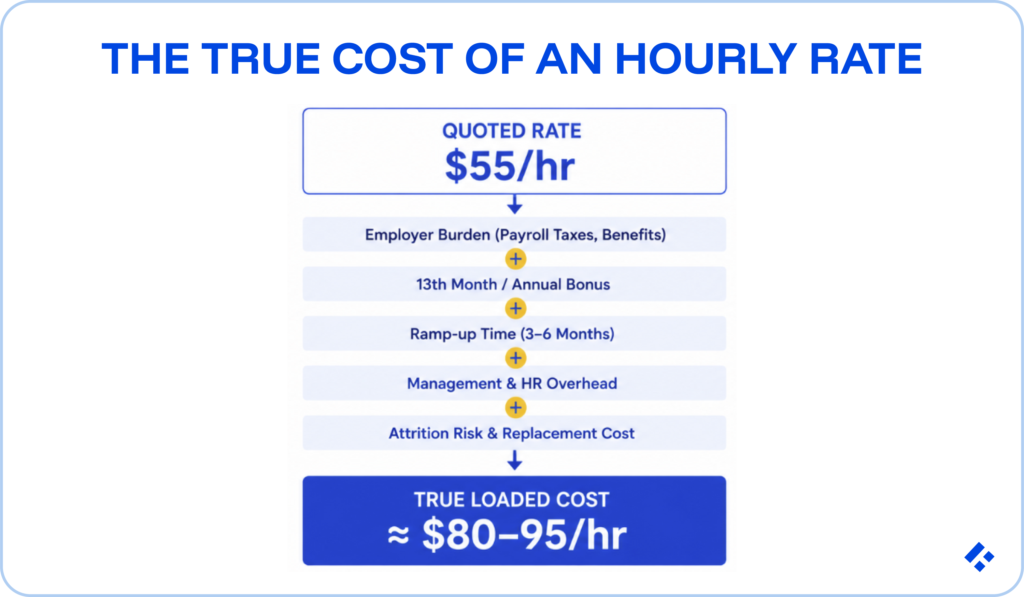
The biggest mistakes some of our clients have made when working with others are assuming that the headline number is the final number. Here's what actually sits underneath a quoted hourly rate:
| Cost layer | What it adds |
| Quoted hourly rate | Baseline |
| Employer social contributions (direct-hire / EOR) | Varies significantly by country, generally highest in Mexico and Colombia, lowest in Chile |
| 13th-month bonus (statutory in most LATAM markets) | Roughly +8.3% of annual compensation |
| EOR platform fee | Roughly $400-600/month per engineer |
| Ramp-up (first 4-8 weeks at reduced output) | Amortized, roughly +8-15% in year one |
| Management overhead (your EM's time) | Roughly +5-10% |
| Attrition and re-hire risk | Roughly +5-12%, depending on the engagement model |
Add it up and true loaded cost typically lands at 1.4-1.8x the quoted hourly rate once ramp-up, management overhead, and attrition are actually priced in.
Direct-hire through an EOR means you carry the burden, the bonus, the platform fee, and all of the attrition risk yourself, so a quoted $55/hr can turn into a real $80-95/hr once everything is counted.
Staff augmentation shifts burden, payroll, compliance, and replacement risk onto the provider, so the quoted rate sits much closer to the true rate.
At Trio, our $40-80/hr band ($7K-14K/month) is the only cost. We absorb all other expenses on our side.
While there are a couple of popular offshore regions that offer cost savings up front, three variables change what a rate actually buys you.
Overlap hours matter. A $22/hr South Asia engineer with 1-2 hours of daily overlap and a $58/hr Colombian engineer with 7 hours of overlap aren't remotely the same.
Async review cycles on a live payments incident cost real days, which may ultimately end up costing more money than you saved up front.
Communication friction is a related cost, but it’s also far harder to quantify. Miscommunications, or a developer who struggles to keep up in an English video call, lead to losses.
Finally, regulatory and contractual proximity, data residency, IP assignment chains, and audit access tend to be simpler to manage in LATAM for a US-regulated fintech.
Usually, companies don’t consider this until it becomes an issue during a SOC 2 audit.
To make sure that you are making the right choice for your company, avoid focusing on dollars per hour, and instead pay attention to dollars per shipped-and-audited feature.
From what we have observed, LATAM rates have climbed noticeably since 2022, and mid-level and senior rates are still moving up a further few percentage points through 2026.
That pressure is concentrated at the senior and specialist end specifically.
This is largely due to the fact that senior LATAM talent is increasingly getting absorbed into full-time EOR arrangements by US employers, which tightens the pool of senior people actually available for contract or staff augmentation work.
Junior and general mid-level rates, by contrast, are flat to soft. AI-assisted tooling has compressed the value of generalist mid-level output in a way that hasn't touched specialist roles at all.
The net effect of all of this is that the spread between a generalist and a fintech specialist is widening.
Let’s take a concrete scenario where a Series A payments startup is building a card-issuing product and needs a five-person offshore pod for twelve months.
| Role | Seniority | LATAM rate | Monthly (160 hrs) |
| Payment engineer | Senior | $88/hr | $14,080 |
| Ledger engineer | Senior | $84/hr | $13,440 |
| Backend engineer | Mid | $50/hr | $8,000 |
| DevOps / SRE | Mid-senior | $68/hr | $10,880 |
| QA / automation | Mid | $42/hr | $6,720 |
| Total | $53,120/mo |
The same five roles at US domestic senior rates run somewhere around $135,000-150,000 a month.
However, this is only a rate comparison, not a full cost comparison.
Once you add compliance tooling, audit preparation, and a QA environment, you will get a real, complete number.
Trio places pre-vetted LATAM fintech engineers, payments, ledger, KYC/AML, and core banking at $40-80/hr, all-in. No employer burden, no EOR fee, and no 13th-month surprise.
Average placement runs 3-5 days, with a 95% developer retention rate.