
Many teams start to hit a wall when their payment workflows rely on old habits.
You know how it goes: slow approvals, confusing handoffs, and surprise charges that no one remembers authorizing.
Over time, these gaps add pressure. Finance ends up working like detectives instead of advisors. Vendors chase updates. Month-end becomes an ordeal that drags on longer than you want to admit.
It often feels like the tools simply weren’t designed for the way modern companies operate. And honestly, that may be true.
Virtual cards help untangle a lot of this. They offer a way to put real rules around spending and build more predictable systems.
If you are exploring B2B payment infrastructure or trying to clean up internal expense management, it tends to open the door to a more controlled and easier workflow.
Below, you will find a practical look at how virtual cards work, where they fit, and how teams use them to simplify payments without adding more friction.
If you want to hire fintech developers to help you implement virtual cards and other innovative b2b payment solutions, our experts can help.
Understanding B2B Payments
B2B payments cover everything from routine invoices to subscription fees and international vendor bills.
They make up the financial plumbing that most companies depend on, although the process often feels heavier than it needs to be.
What Is B2B Payment?
A B2B payment is simply a transaction between two businesses.
It may be automated or manual, large or small, and connected to anything from software licenses to wholesale orders.
Traditional Payment Methods: ACH, Wire, and Checks
ACH transfers are common because they are inexpensive, though the multi-day wait can slow things down.
Wires arrive quickly but cost more than most teams want to spend on everyday payments.
Checks still circulate in certain industries, especially where long-standing habits or audit preferences keep them alive.
All of these methods are quite outdated if you consider the modern payment methods available with the rise of digital banking and improvements in real-time payments.
Limitations of Legacy B2B Payment Systems
These older methods create both delays and uncertainty.
Reconciliation takes longer. Visibility drops.
Fraud risk also increases because shared numbers or static accounts remain active for far longer than they should, and modern security measures often aren’t integrated into these systems.
The Role of Virtual Cards in B2B Transactions
Virtual cards give finance teams a way to simplify these workflows.
They provide more control and reduce the guesswork that comes with shared cards or vague line items.
What Are Virtual Cards and How Do They Work?
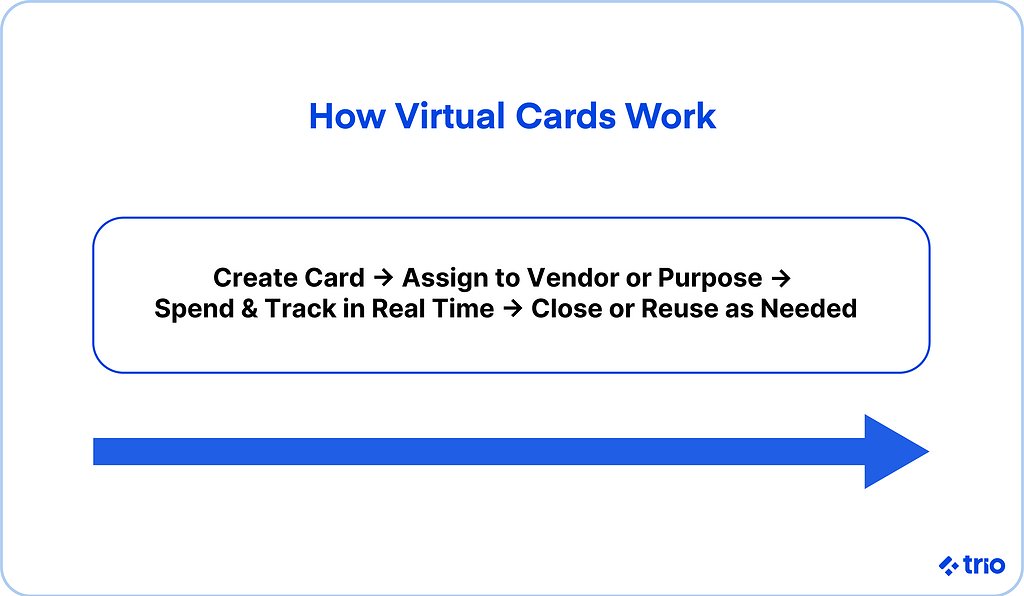
A virtual card is a temporary card number tied to a central account.
You can generate it instantly, assign it to a specific vendor or purpose, and shut it down whenever you need to. Many of them also expire far faster than normal cards automatically.
Key Differences Between Physical and Virtual Corporate Cards
Physical cards are fixed. Virtual cards are flexible.
Teams create as many as they need and apply rules that fit the situation.
That may include limiting the merchant type or setting a maximum spend.
Enhancing Financial Control and Transparency
Finance teams often want better visibility without micromanaging.
Virtual cards offer that middle ground.
Real-Time Expense Tracking and Spending Limits
Transactions appear immediately in most cases, which is incredibly useful compared to some older payment processes.
You can set limits that match your budget, rather than waiting for someone to overspend by accident.
Streamlined Vendor Management and Payment Approvals
Creating a unique card for each vendor removes a lot of uncertainty.
It becomes easier to approve payments because every charge is connected to a clear point of origin, which can be easily traced by both parties involved.
Improving Efficiency for Finance Teams
Virtual cards cut out many of the repetitive tasks that slow finance operations.
Faster Settlement and Reconciliation
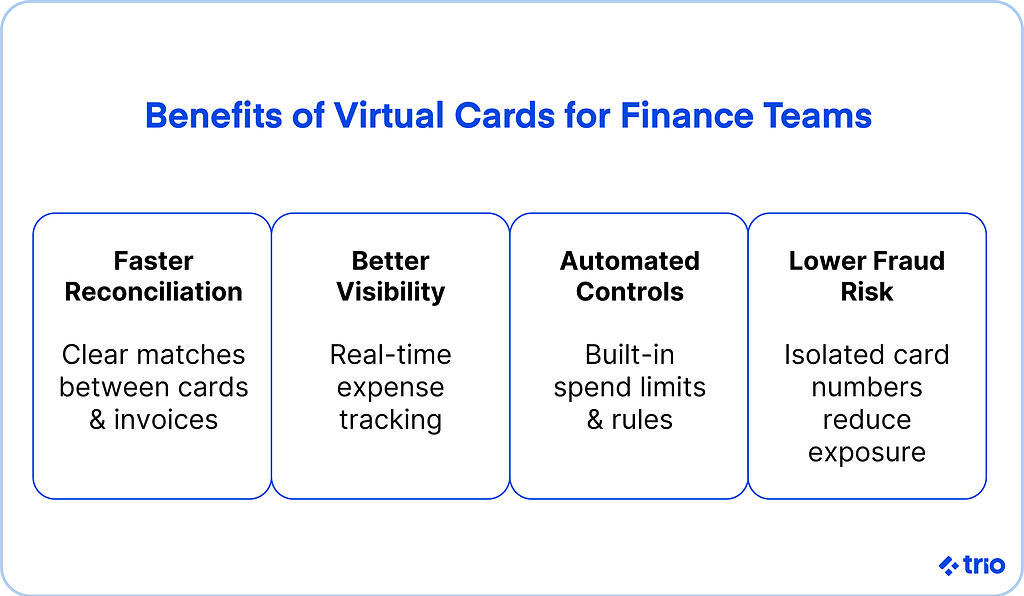
Because each card is tied to a single purpose, payments usually match invoices with far less effort.
In the accounting teams with which our developers have worked, we have noticed that month-end feels lighter once they adopt this approach.
Reduced Administrative Overhead with Automation
Most platforms apply rules automatically when you use digital cards.
They categorize expenses, enforce limits, and collect documentation as part of the process, rather than as a follow-up task, utilizing AI and ML to automate these processes.
Enhancing Payment Security with Virtual Cards
Security concerns tend to rise as companies scale. Virtual cards appear to reduce these risks in several practical ways.
How Virtual Cards Improve Payment Security
Each card number is isolated.
If one is compromised, you close it and move on. It does not interrupt the entire payment system.
Tokenization and One-Time-Use Card Numbers
Temporary numbers and tokenization make it harder for attackers to reuse stolen information.
Our developers are also experimenting with new tools like Tokenization as a Service to make this even easier and more cost-effective for our fintech clients to secure any card payments.
This approach is often more secure than passing around a physical card in the office.
Reducing Fraud Risk in Corporate Transactions
Because every card has a purpose, suspicious activity stands out quickly.
Not only is it more likely that issues will be detected in manual reviews, but it is also easier to train fraud detection algorithms, making it more likely that the fraud will be successfully prevented.
This helps prevent both external attacks and internal misuse.
Best Practices for Secure Transactions
Role permissions, controlled issuance, and ongoing monitoring enhance both the system’s effectiveness and its security.
These steps may seem simple, but they can make a noticeable difference.
Compliance With PCI DSS and Data Protection Standards
Unique card numbers and controlled scopes help reduce exposure, especially for commercial cards that may contain other sensitive information.
This makes compliance easier for teams that do not want to carry a heavy operational load.
Vendor Risk Assessment and Card Usage Policies
Assigning a dedicated card to each vendor helps you manage risk at a very granular level.
You can tighten or loosen rules depending on the relationship.
Automating Spend Management Processes
Automation becomes far more achievable once virtual cards are part of the picture.
Integrating Virtual Cards Into ERP and Accounting Systems
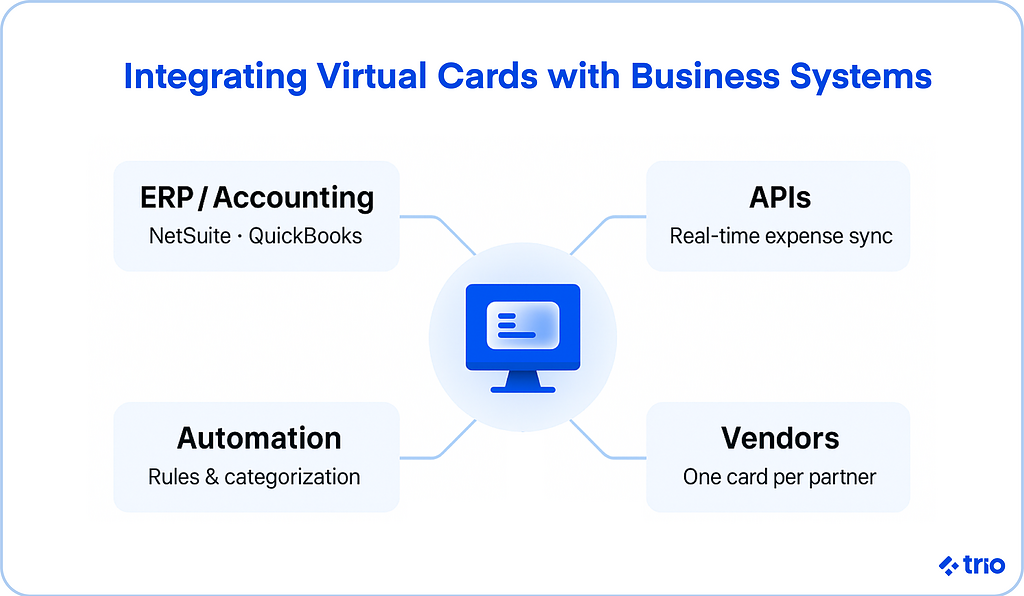
API integrations allow virtual card data to sync with systems like NetSuite or Intuit QuickBooks.
The card rules can mirror the structure of your chart of accounts.
Leveraging APIs for Real-Time Expense Categorization
Categorization can happen at the moment of payment.
This may reduce end-of-month cleanup work.
Reconciliation Made Easier With Virtual Cards
One card per vendor usually results in cleaner matches. This reduces the number of invoices that require manual review.
Instant Matching of Payments and Invoices
Because cards follow specific rules, the expected transactions align with actual charges.
You avoid the uncertainty that comes with generic payment methods.
Smarter Business Payments for Finance Teams
Virtual cards create more adaptable financial workflows.
You configure them to match your internal structure instead of forcing teams into rigid systems.
Aligning Virtual Cards With Business Needs
You can issue cards for projects, travel expenses, events, contractors, or recurring software.
It may sound small, but it gives teams a clearer way to separate expenses.
Departmental Budgets, Vendor Payments, and Subscriptions
Since you can separate all of your departments, budgets become easier to track.
Subscription creep becomes less of an issue because each tool or service has its own card.
White-Label and API-Driven Virtual Card Platforms
Some companies integrate virtual cards into their own software.
Trio often works with clients who want to embed card issuance and management into custom products.
These projects typically require careful design around compliance and infrastructure, which is why you need developers who specialize in the industry and understand the unique requirements.
Global Enterprises and Virtual Card Integration
Cross-border operations come with their own challenges. Governments have different rules, and sometimes even entirely different banking processes.
Virtual cards are not a perfect solution for everything, but they do help with consistency.
Multi-Currency and Cross-Border Payment Support
Some providers support multiple currencies.
This reduces friction for teams handling international vendors or travel. You can pay in your own currency, and the conversion occurs automatically, so your vendors are paid accordingly.
Embedded Virtual Cards in Procurement and Travel Platforms
Procurement and travel systems often pair well with virtual cards.
They provide clearer audit trails for high-frequency or high-variability expenses.
Future Trends in B2B Payment Solutions
B2B payments are shifting toward more connected and programmable systems.
Virtual cards appear to be part of this shift rather than a passing trend.
The Shift to API-Based Payment Orchestration
More companies are building payment stacks that rely on modular APIs rather than monolithic tools.
It offers a level of control that finance and engineering teams often prefer.
Sustainability and Compliance in Payment Innovation
Digital payments often replace paper processes. This shift can support sustainability goals for companies that track those metrics.
Virtual cards reduce paper invoices and manual signatures, too. It is a small step, but it scales across a growing company.
And finally, clear audit trails help companies meet reporting expectations for both normal regulations and those related to sustainability. This makes compliance less of a scramble.
Conclusion
Virtual cards offer a practical way to improve B2B payments and expense management.
They help finance teams gain clarity, reduce errors, and simplify the workflow around everyday spending.
If your company is exploring virtual cards or looking to build a full payment solution, Trio can help with the engineering and product strategy behind it.
Our team works closely with clients who need secure, compliant, and scalable payment tools, whether that means embedding card issuance, building custom expense platforms, or developing API first financial systems.
To find out if we have the right fintech specialists for you, get in touch!
FAQs
What is a virtual card in B2B payments?
A virtual card in B2B payments is a digital card number created for a specific use, and it lets your team control spending with clear rules and real-time visibility.
How do virtual cards help with expense management?
Virtual cards help with expense management by assigning each vendor or project its own card, which makes tracking, categorization, and reconciliation far more accurate.
Are virtual cards more secure than physical cards?
Virtual cards are more secure than physical cards because each number is isolated, and compromised cards can be closed without disrupting the rest of your payment system.
Can virtual cards integrate with my accounting software?
Virtual cards integrate with accounting software through APIs that sync transactions, categories, and rules directly into tools like NetSuite or QuickBooks.
Do virtual cards work for international payments?
Virtual cards work for international payments when the provider supports multiple currencies, which helps global teams manage vendors and travel more consistently.
How do virtual cards reduce fraud?
Virtual cards reduce fraud by using tokenized, purpose-specific numbers that highlight unusual charges and prevent attackers from reusing stolen data.