

Hire by Technology
SERVICES



Choosing between React and Next.js in fintech carries more weight than in most other sectors.
A real-time trading dashboard has fundamentally different requirements than a customer-facing loan comparison tool. The framework that serves one can actively work against the other, and making the wrong choice at the start can lead to extremely costly reworks.
React is a JavaScript library for building user interfaces, while Next.js is a full-stack framework built on top of React that adds server-side rendering, static site generation, file-based routing, and API routes out of the box.
You cannot use Next.js without React, but you can use React without Next.js.
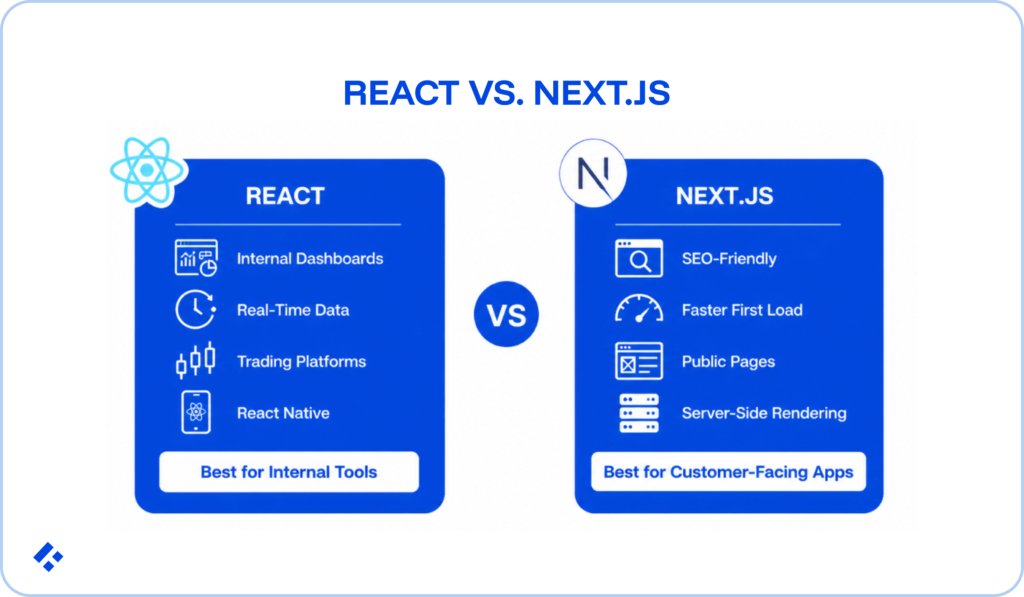
In general, we recommend that fintech firms use React for their internal tooling and consider Next.js for consumer-facing products. However, the right choice will depend on your specific situation.
Let’s look at the two, comparing them directly to one another. We’ll explain the performance and SEO trade-offs, and provide fintech-specific guidance on which to reach for in which context.
At Trio, we provide pre-vetted developers with several years of experience in production fintech industries. These developers simply need to be placed after we determine your needs. This means you can access expert talent in as little as 3-5 days.
React is a JavaScript library developed by Meta. It provides a powerful and efficient way to build user interfaces for web applications, with a component-based architecture that lets developers create reusable, modular UI elements.
In fintech, React has become the default choice for many of the most demanding user interfaces.
Payment platforms like Stripe provide dedicated React libraries for their checkout components because component-based architecture suits the modular, embeddable nature of payment UIs.
Trading platforms and brokerage dashboards frequently rely on React for its ability to handle real-time data updates efficiently without full page reloads.
Robinhood's web trading interface, for example, uses React for exactly this reason.
Next.js, built on top of React, is a framework specifically designed to extend React with server-side rendering, static site generation, file-based routing, and built-in API support.
The Next.js team at Vercel positions it explicitly as building blocks to create fast, full-stack web applications.
Next.js has become the standard for customer-facing products that need both performance and discoverability.
Financial comparison sites, mortgage rate calculators, neobank customer portals, and financial product landing pages all benefit from Next.js's SSR and SSG capabilities.
Any fintech company investing in organic acquisition through search needs the SEO advantages that server-side rendering provides.
To start using React, you first need to install Node.js and npm, then create a new project using Create React App or Vite.
From there, you define components using JSX, a syntax extension that combines HTML-like markup with JavaScript.
React's unopinionated nature means you'll add your own choices for routing (typically React Router), state management (hooks, Redux, or Zustand), and data fetching.
Next.js provides a streamlined setup via the create-next-app command. Since it builds on React, prior React knowledge is not optional.
Once set up, routing comes from the file structure itself. In other words, each file in the pages or app directory maps to a route.
TypeScript is then configured by default in recent versions, which removes a common setup step for teams building in financial environments where type safety matters.
React has a very broad ecosystem, thanks in part to the large developer community. It covers most requirements that a fintech frontend team is likely to encounter:
The tradeoff here is that assembling these libraries requires evaluation and ongoing maintenance, which requires a certain level of experience, and can rapidly consume developers’ time.
If your financial applications have particularly long development lifecycles, this accumulated dependency overhead can slow teams down.
Next.js consolidates many of these decisions into a single framework.
Its built-in features cover routing, server-side rendering, API development, image optimisation, and TypeScript support, allowing you to reduce the number of external dependencies a team needs to evaluate and maintain.
| Feature | React | Next.js |
| Type | UI Library | Full-Stack Framework |
| Rendering | Client-Side (CSR) by default | SSR, SSG, ISR, and CSR |
| Routing | External library (React Router) | Built-in, file-based routing |
| Data fetching | Client-side hooks | Server Components, pre-fetching |
| SEO | Harder to optimise | Excellent out of the box |
| API routes | Not included | Built-in |
| Image optimisation | External libraries | Built-in next/image |
| TypeScript | Supported | Configured by default |
| Learning curve | Moderate | Moderate (requires React knowledge) |
| Talent pool | Very broad | Growing; narrower than React |
| Best for | SPAs, dashboards, internal tools | Public apps, e-commerce, SEO-heavy sites |
React's virtual DOM diffing algorithm optimizes rendering by drastically minimizing costly updates to the actual DOM.
However, React still primarily relies on client-side rendering. This produces slower initial page loads because the browser must download, parse, and execute JavaScript before rendering content.
Next.js addresses this performance issue directly.
Server-side rendering delivers fully rendered HTML to the client, and static site generation serves pre-built pages from a CDN.
Both of these approaches produce faster initial load times than client-side-only React.
In fintech, this performance difference has real business consequences. Even small delays on a payment or conversion page have the chance of decreasing completion rates.
For publicly accessible financial products, checkout flows, and account opening pages, Next.js's rendering options provide a measurable advantage.
If you are working on internal tools and dashboards where engineers are already authenticated and load time is a secondary concern, then React's client-side rendering tends to be sufficient.
As already mentioned, React’s client-side rendering can lead to slower initial page loads. This, in turn, can cause difficulties in search engine indexing because the content depends on JavaScript to render.
Google's crawler does handle JavaScript, but the process introduces delays that affect ranking.
Next.js, as discussed, generates fully rendered HTML on the server, ensuring that search engines receive indexable content immediately.
If your fintech company is going to be investing in content marketing, rate comparison tools, eligibility calculators, or any public page competing for organic search traffic, this distinction makes a difference.
A financial product landing page built in Next.js will consistently outperform the equivalent client-side React page in search indexing speed.
To provide the best chance of acquiring customers through organic search, which includes comparison sites, neobanks, lending platforms, and insurance products, taking advantage of this SEO benefit translates directly into acquisition cost.
React applications deploy straightforwardly to any static hosting platform, such as Netlify, Vercel, AWS S3, or something similar.
Next.js applications also deploy to these platforms, but they take full advantage of serverless infrastructure for SSR and API routes.
Vercel, which maintains Next.js, provides the most seamless deployment experience, while AWS Lambda and Edge functions are the better choice if you need more custom configurations.
If you are dealing with financial applications that have compliance requirements around data residency, both frameworks support region-specific deployment.
Next.js API routes also allow sensitive operations to run in specific geographic regions rather than globally distributed edge nodes, which matters for financial regulations that restrict where customer data can be processed.
React alone tends to work better in fintech contexts where:
Next.js tends to be the better choice in fintech when:
We have covered the basics of React and Next.js, but there are several specific considerations for fintech environments that further shape your framework decision:
When hiring frontend engineers for a fintech project, there are a couple of different skills you need to look for.
All of the above, plus:
Finding senior engineers who combine strong Next.js or React expertise with genuine fintech domain knowledge is incredibly difficult.
These are two entirely separate sets of skills that take time and effort to learn independently.
If the hiring timeline matters, like when you are approaching a compliance deadline, working with a specialist staffing partner tends to be faster than running a full search cycle from scratch.
React and Next.js serve different purposes. In fintech, we recommend that you use React for internal applications where SEO is irrelevant and real-time data handling matters, and Next.js for public-facing products where page speed and search visibility affect acquisition and conversion.
A single product often contains both a public marketing layer (Next.js) and an authenticated dashboard (React).
Understanding where each framework is most suitable avoids overengineering one part of the stack while underserving another.
If you're considering hiring a senior React or Next.js developer with fintech experience and want to reduce screening and interviewing time, consider working with a specialist tech partner like Trio to hire faster and smarter.