

Hire by Technology
SERVICES


Claude Code and Cursor are two very popular options for developers trying to improve productivity. But these AI-powered coding assistants are different enough that where you use them matters.
The general Claude Code vs Cursor debate had mostly settled at this point.
Claude Code tends to win for complex, autonomous architectural work. Cursor tends to win as the daily driver.
However, there are additional considerations you need to make once you're building payment systems, KYC pipelines, or anything else that touches regulated financial infrastructure.
This piece walks through data handling questions, specific financial failure models, and what Claude Code's CLAUDE.md configuration offers fintech-specific capabilities.
At Trio, we pre-vet fintech experts who can help you make the most of these tools, choose the right one for your application, and develop in such a way that your products are not only compliant but set up to scale.
Both Claude Code and Cursor send code out to external AI APIs for processing. For most engineering teams, that's a fairly ordinary IP and privacy consideration, but if you’re building something that touches cardholder data, it raises a PCI DSS scoping question, too.
Before rolling either tool out across your payment engineers, it's worth working through one question: Does the code you're sending to the AI API count as cardholder data, or does it just describe how cardholder data gets handled?
In most cases, application code doesn't count as cardholder data under PCI DSS. But code containing hardcoded test credentials, real payment data pasted in for debugging, or schema definitions with card fields needs a closer look.
Historically, Cursor's SOC 2 Type 2 certification and zero data retention option have lived at its higher-tier team plans, often called Business or Enterprise, and priced around $40 per seat per month, alongside admin controls, SSO, and privacy mode.
For compliance teams evaluating AI tool governance, this has generally offered the clearest third-party certification story among the major AI coding tools.
The entry-level Pro tier ($20/month) has not historically carried SOC 2 certification on its own, so teams running individual Pro subscriptions and assuming SOC 2 coverage are working from an assumption worth double-checking.
However, having said all of that, Cursor's plan structure and pricing have changed more than once through 2026, so confirm current tier names and what's included directly on Cursor's site before you build a compliance narrative around them.
Claude Code runs through Anthropic's API under enterprise data-handling policies.
Anthropic maintains a HIPAA-eligible posture, an enterprise DPA, and a policy of not training on customer code submitted via the API.
If your fintech team has any HIPAA obligations or strict data processing requirements, that generally offers comparable regulated-environment coverage to Cursor's SOC 2 certification, even though the certification types aren't identical.
Sometimes data residency truly can't be negotiated. In these cases, an open-source, self-hosted option like OpenCode (MIT-licensed, Ollama-backed) routes nothing outside the machine at all.
For most fintech teams, either Claude Code Pro or Cursor's higher compliance tier probably provides enough governance to work with.
Veracode's GenAI Code Security research, first published in 2025 and updated through 2026 with newer flagship models included, has consistently found that around 45% of AI-generated code introduces OWASP Top 10 vulnerabilities.
That figure seems to have held up across more than a hundred models and multiple testing rounds, even as raw syntax correctness has climbed above 95%. In other words, the code increasingly looks right and often isn't.
Apiiro's research across Fortune 50 enterprises found that AI-assisted development correlates with a noticeably higher rate of design-level security flaws (researchers have cited figures north of 150% more), including authentication bypass and improper session handling.
This has, of course, led to a sharp jump in privilege escalation paths.
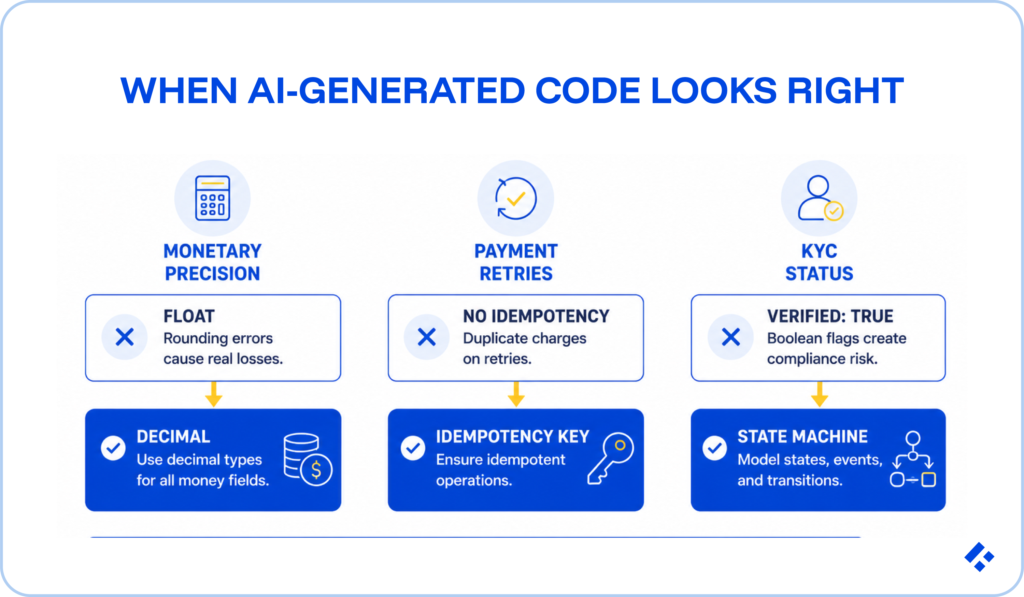
For fintech engineering specifically, the individual failure modes matter. Here are some of the most common failure modes we have encountered:
Left without explicit constraints, an AI model will often default to FLOAT or DOUBLE for monetary amounts, the IEEE 754 floating-point types that can't represent many decimal fractions exactly.
For a single transaction, the rounding error is basically invisible, but across ten million transactions, it turns into real reconciliation discrepancies that surface during audits or regulatory exams.
Neither Claude Code nor Cursor prevents this by default.
AI-generated retry code frequently skips client-generated idempotency keys, which opens the door to charging a customer twice after a network failure.
The code is often missed if you have junior developers or generalists, because it reads as syntactically fine, and a developer reviewing purely for logic bugs might not catch it.
Models tend to default to the simplest representation of verification state, something like a single verified: boolean.
The actual regulatory requirement is closer to a stateful lifecycle, with defined transitions, ongoing monitoring states, and enhanced due diligence triggers.
This is often caught in regulatory examinations.
None of these issues means the tools are inherently unsafe to use. It just means the engineer reviewing AI-generated output in a fintech context needs to understand these specific failure modes.
Now that you understand where using an AI-coding assistant might be problematic, let’s look at why you might still want to use Claude Code specifically.
Payment services, compliance workflows, KYC pipelines, multi-entity ledgers, and the integration layer connecting all of it typically span more files and more cross-service dependencies than basic consumer software.
Claude Code's 1M token context window on Opus 4.8 and Sonnet 4.6 lets it read an entire fintech codebase in one pass, including the payment service, its dependencies, the test suite, and existing integration contracts, before making a change.
This tends to produce coherent, context-aware edits instead of local patches that break stuff downstream.
CLAUDE.md is a configuration file that persists codebase context across Claude Code sessions.
This lets you encode the domain conventions that prevent the most common AI-generated financial code errors before Claude Code writes a single line.
A fintech-focused CLAUDE.md might look something like this:
# Monetary conventions
# Payment idempotency
# KYC state machine
# PCI DSS scope
This will let Claude Code start each session already knowing not to suggest FLOAT, not to skip idempotency keys, and not to log card data, which covers three of the more common fintech-specific errors.
Anthropic recommends keeping CLAUDE.md under roughly 200 lines with verifiable instructions. It loads every session, so every line is a recurring cost.
Claude Code's subagent system lets a lead agent spawn specialized subagents to work in parallel.
For fintech teams, setting up a dedicated security-focused subagent to check architectural changes against the CLAUDE.md compliance rules before a PR goes out creates an automated first pass that catches fintech-specific errors general security scanners tend to miss.
Cursor has some specific advantages, which make it the right choice in a variety of conditions.
If your security policy requires third-party certification on any AI tool touching code, Cursor's higher-tier plan generally provides SOC 2 Type 2 certification and a zero data retention option.
For conversations with compliance officers or QSAs, pointing to a named SOC 2 certification tends to land better than pointing to enterprise DPA language alone.
Cursor's Composer Agent handles multi-file natural language changes, which covers a lot of routine fintech feature work like adding a new payment method, extending a KYC flow, and building out a new fee calculation.
Cursor's Bugbot runs as an add-on that flags likely bugs before a human reviewer even opens the PR
An automated pre-review pass that catches obvious logic errors before they reach your busiest senior engineer cuts down the review burden meaningfully.
When paired with CLAUDE.md-style explicit constraints, Bugbot can handle general code quality while the human reviewer focuses on fintech-specific domain judgment.
What most of us in the fintech sector have realized by now is that most senior engineers end up running both tools, applying each to a different phase of the workflow.
For both, at a high enough level that your developer has everything they need, you are looking at roughly $60 per developer, per month.
Both tools amplify what an engineer can do, but also amplify mistakes. And, while tool configuration reduces how often these errors slip through, it doesn't remove the need for a reviewer who actually understands the domain.
Five competencies tend to separate an engineer who can safely review AI-generated financial code from one who can't:
| Decision factor | Claude Code | Cursor |
| Primary workflow | Terminal-first agent, autonomous task dispatch | IDE-first, daily inline editing |
| Fintech codebase complexity | 1M token context, entire codebase in one session | 200K default; larger context available with settings adjusted |
| Compliance context config | CLAUDE.md encodes fintech conventions and persists across sessions | Project Rules, a similar concept, is scoped to the IDE |
| Data handling certification | HIPAA-eligible posture, Anthropic enterprise DPA, no training on customer code | SOC 2 Type 2 historically at higher-tier plans (~$40/seat), with a zero data retention option |
| Security review layer | Subagent security-engineer pattern | Bugbot AI PR review (add-on) |
| Financial logic constraints | CLAUDE.md prevents common fintech errors when configured | Requires manual rule-setting; no default financial logic constraints |
| Best for fintech | Architectural work, compliance audits, complex refactors | Daily feature work, PR review, interactive debugging |
| Individual plan price | $20/seat (Pro) | $20/seat (Pro) / ~$40+/seat for compliance tier |
For most fintech teams, the best approach is to use the Cursor's compliance-tier plan for daily development and governance, Claude Code Pro for architectural work, one shared CLAUDE.md encoding fintech compliance conventions across both tools, and domain-aware senior engineers reviewing AI output for the failure modes tooling doesn't catch on its own.
Related Reading: Fintech Hiring Slowdown
AI coding tools change fintech engineering capacity. But if you try to use these tools without engineers who can spot monetary precision errors, idempotency gaps, and KYC anti-patterns, your speed may outpace your ability to mitigate risks.
Trio places pre-vetted LATAM fintech engineers who bring both tool fluency and domain knowledge to use it safely.
Our pre-vetted engineers understand why FLOAT is never acceptable for monetary amounts and will catch it in AI output. That domain knowledge is what turns amplification into something safe rather than fast and risky.
For any fintech team adopting Claude Code, Cursor, or both, the return on that investment mostly depends on whether the engineers reviewing the output actually understand what they're looking at.
If you want to hire senior fintech developers, request a consult.