
Hire by Technology
SERVICES


Payment gateway integration is an absolutely essential feature for even the most basic MVP. If done correctly, the integration allows your company to monetize its products securely, making the implications of a poor integration a direct, negative effect on your income.
Since your business success hinges on it, you need to get your payment processor to work correctly with the rest of your web and mobile apps.
Waiting until your product is already established is leaving money on the table, but at the same time, rushing the integration process or going with the wrong payment gateway provider could be incredibly detrimental, especially to your compliance strategy.
Let’s take a look at everything you need to know to ensure a successful integration, including a variety of information, nuances that you should understand, and seven simple steps for the actual integration process.
Our skilled fintech developers have production experience in building and integrating payment gateways, so they can walk you through the entire process, from the initial choice to the integration, and perhaps even building your own payment gateways from scratch.
Payment gateway integration is the process of connecting payment gateway software, or a digital payment system, to your website or app.
This kind of technology is used in almost every e-commerce platform and financial service provider, so that their customers can make secure online payments using their credit and debit cards.
To provide users with the most convenience, a lot of businesses also integrate digital wallets like PayPal alongside basic gateways.
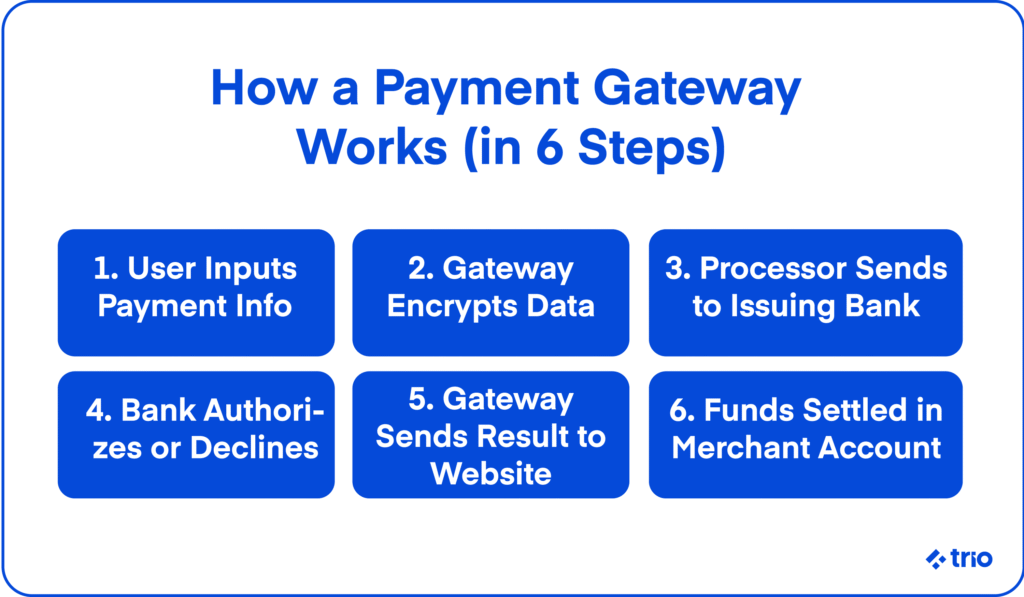
The first step is, of course, when the customer initiates a purchase and inputs payment details on your platform during checkout.
Your website or application then sends the encrypted data to the payment gateway, provided you've integrated it correctly.
The gateway routes the request to a payment processor, either bundled in with the gateway service or chosen separately, after which the processor seeks authorization from the customer's issuing bank, which runs its own fraud checks and confirms available funds.
Once approved or declined, the gateway communicates the result back to your platform, and funds settle into your merchant account.
This settlement often happens in batches, sometimes alongside payment links for easier access.
As you can imagine, real-time processing matters a great deal. A delay in checkout causes abandoned transactions, and downtime leads directly to lost revenue, so each of these steps needs to happen as quickly as possible.
One underappreciated part of this flow that many of our clients who are struggling have often overlooked is webhooks.
Payment events like a delayed authorization, a chargeback, or a payout confirmation don't get communicated back to your app in real time through the normal API response. Webhooks handle this instead.
In doing this, your server is notified asynchronously, and your system stays in sync with the gateway even when something happens minutes or hours after the original transaction.
The payment gateway is like a digital point-of-sale terminal; it's what captures and encrypts payment data.
The payment processor handles the transfer of funds.
When people refer to a merchant account, they are talking about your account. Specifically, the one where the money ultimately ends up.
When choosing a provider, think about what exactly they offer because not every one covers everything you would expect.
Some are exclusively the gateway, while others bundle all three functions and more.
Providers that bundle everything simplify your operational setup considerably: one support team, one dashboard, sometimes simpler pricing too. The tradeoff is less flexibility to swap out any individual component later.
There are several main approaches: hosted gateways, integrated or API-based gateways, self-hosted gateways, the direct post method, mobile and in-app solutions, local bank integration, and fully custom-built solutions.
Let’s take a look at what all of these entail, so you can understand what might suit your situation the best.
Hosted gateways redirect the user to a secure, third-party page that handles payment and data security on its own.
In our experience, these are the easiest to set up, and they remove most of the PCI DSS compliance burden from your side entirely.
The tradeoff is losing control over the checkout experience, which makes your specific choice of hosted provider more important than it might first appear.
As the name suggests, your frontend and backend connect directly to the gateway, usually via API or SDK.
This is great if you need more control over the UI, but you take on the security and compliance work yourself.
This is the option most e-commerce platforms and marketplaces that we have worked with ultimately reach for when checkout continuity and conversion matter more than setup speed.
Self-hosted gateways have the most complex integration method, but they are also the most flexible. All transaction logic and customer data live on your own infrastructure.
This is often a good fit for larger enterprises with custom workflow needs and the resources to carry the full PCI DSS burden themselves, since that responsibility no longer sits with a provider.
In the direct post method, customer data gets "posted" to the gateway directly from the client's browser.
Some people like this because security requirements ease slightly compared to some other methods, but careful implementation still matters.
Mobile-specific gateways can almost be seen as a whole category of their own.
These gateways are built specifically for touchscreen checkout, optimized for smaller screens and the interaction patterns mobile commerce actually needs, not just a responsive version of a desktop form.
SDKs let you build payment processing directly into your app, and this is usually the right call if you're offering a fintech service like a digital wallet, peer-to-peer payments, or mobile banking.
In most cases, such as situations where you have a website that people might access via their phone, processors like Stripe are more than enough.
Local bank payment integrations are more regional by nature. As the name suggests, these providers connect to banks and mobile money platforms specific to one location.
If you're targeting a particular country or region, this avoids over-relying on international processors that may not handle local payment preferences well.
Anything custom-built is going to be the most labor-intensive and expensive option by a wide margin. Payment gateway solutions are no different, but this option is genuinely worth it if you have a unique business model or very high transaction volumes that no off-the-shelf provider handles well.
Just make sure that you budget real time and money for security, compliance, and network connectivity; none of that comes for free once you own the whole stack.
Point-to-point encryption deserves a specific mention because, unlike standard TLS, it scrambles card data from the moment of capture, at the physical or digital input point, and keeps it encrypted all the way to the processor's decryption environment.
If your business qualifies for a PCI-validated P2PE solution, this lets you shrink your compliance exposure greatly.
We have noticed a few trends worth building toward now if you want an integration that still holds up in two or three years.
Apple Pay and Google Pay skip manual card entry and lean on device-level security, which tends to improve conversion, especially on mobile.
Buy now, pay later options like Klarna and Afterpay have gone mainstream too, so much so that customers have almost come to expect them in checkout flows.
Regional methods deserve real attention too. iDEAL dominates in the Netherlands, UPI processes billions of transactions in India, and ACH transfers remain the B2B standard in the US.
These previously advanced security measures are becoming baseline infrastructure.
Swapping raw card data for tokens that hold no standalone value shrinks compliance exposure and limits the blast radius of a breach, while still keeping recurring billing and one-click payments practical.
Recent developments in offerings like Tokenization-as-a-service are minimizing the amount of work you have to do as well.
3-D Secure and biometric verification are some popular examples of how authentication is growing.
A fingerprint or facial recognition check adds a step but cuts fraud and chargebacks meaningfully.
However, while these measures decrease things like fraud, you also need to balance friction.
Large models, driven by AI and ML, can analyze behavior patterns, device fingerprints, and transaction history in real time, picking up on even small changes almost instantly.
Realistically, this isn’t going to eliminate fraud outright, but it has already been shown to improve accuracy, which means fewer legitimate customers get blocked at exactly the wrong moment.
Speed and simplicity can be seen as core features now.
Fewer redirects, faster authorization, and clearer error handling are just some technical ways our developers are improving user experience.
Reducing form fields to only what's strictly necessary and offering guest checkout instead of forcing account creation remain some of the biggest changes we have come across.
We recommend that you start with your business model and audience. A SaaS business needs a gateway optimized for subscriptions and recurring billing, while a global business needs broad payment-type support and may need regional vendors.
Documentation and developer support quality matters too, since poor documentation leads directly to longer integration timelines and a higher chance of misconfiguration.
Choosing a reputable, actively maintained provider is critical because APIs evolve, security standards update, and a provider that keeps its SDKs current saves your team from discovering a deprecated endpoint.
Fee structures also become critical as you grow, with some providers charging extra for API-based transactions on top of standard processing, and others bundling full API access into one transparent rate.
Setup and monthly fees are common. But, from what we have observed, it looks like many modern providers have dropped setup fees entirely to lower the barrier to onboarding.
If there are fees, startups and scaleups of a certain size can sometimes negotiate a waiver.
Per-transaction charges are the most common ongoing cost, typically a percentage of the transaction value plus a small fixed fee.
Most commonly, we see these costs sit at somewhere around 1.4% plus a fixed amount for European cards. These add up fast at real volume, even though they feel minor per transaction.
Cross-border fees and currency conversion can get expensive fast for international operations, largely a result of the extra fees and processes involved on the gateway's side. Staying within one region limits this exposure.
Chargeback and fraud handling costs are close to unavoidable. They can be expensive too, at $15 to $40 per incident depending on the provider, regardless of how strong your security measures are.
Development, maintenance, security, and PCI compliance round out the list. Some companies try to skip this early on, but adding features later means paying for the additional development, integration, and testing all over again.
Finally, think about opportunity cost.
Saving money on a cheaper plugin or a stripped-down feature set can cause real transaction abandonment.
While integrating a pre-made payment gateway is the right choice in most situations, there are a couple where we recommend that you build.
Custom solutions make sense with the time, money, and control requirements to justify them, or when transaction volume genuinely demands it.
As we have already mentioned, they're also worth it for truly niche requirements nothing else provides.
Just keep in mind that the internal expertise required is often too costly to justify, even with nearshore or offshore development in the mix.
What many businesses actually benefit from instead is a hybrid model.
You integrate multiple gateways for redundancy and risk management, or combine an existing gateway with custom development to fill a specific gap.
PCI DSS specifies how you handle sensitive credit card data. It is usually complemented by frameworks like EMV and 3-D Secure to reduce fraud further.
You'll deal with PCI DSS regardless of where you operate, but some regions have additional layers that you need to think about.
Europe's GDPR and California's CCPA both touch data handling directly.
Choosing the wrong provider creates a poor user experience and scaling headaches later. Skipping thorough testing and documentation is another way to create these same issues.
Similarly, skipping PCI compliance just means you’ll have to bolt it on afterwards when it’s more expensive to add.
Skipping webhook setup specifically catches teams off guard post-launch, since they end up without proper event handling.
While it is far less common, we have also seen inexperienced developers integrate outdated SDKs or fail to track API deprecation notices. This introduces fragile code that breaks silently.
Our experienced developers have also mentioned that requiring account creation before checkout can increase abandonment. Guest checkout, wherever the gateway supports it, removes a real barrier for first-time customers specifically.
Integrating payment gateways is largely unavoidable if you want to accept online payments of any kind.
Regardless of the option that you decided to go with, integrating something like Stripe or building a custom solution, having an experienced team on hand makes a real difference.
Downtime or a clunky checkout can cost sales just as easily as a security gap can. In many cases, they can even lead to costly fines and regulatory action when issues are picked up during audits.
At Trio, we have a pool of pre-vetted fintech experts who have done countless of these integrations successfully.