Banks everywhere are wrestling with issues related to the fact that the fintech landscape keeps moving faster, and the people needed to build modern systems are getting harder to hire.
On top of the rapid development of the industry itself, AI tools are reshaping workflows, regulations are continuing to shift, and customers expect clean, digital-first experiences that simply cannot be delivered without the right engineers and product talent.
If you’re noticing a growing gap between what your organisation needs and what your workforce can handle, you’re not imagining it. The pace of change in financial services has outgrown traditional hiring and talent acquisition models.
Even well-resourced institutions are struggling to attract the kind of fintech talent that can support new digital payment systems, data analytics, cybersecurity upgrades, and the dozens of operational areas shifting toward automation.
The encouraging part is that this problem isn’t unsolvable.
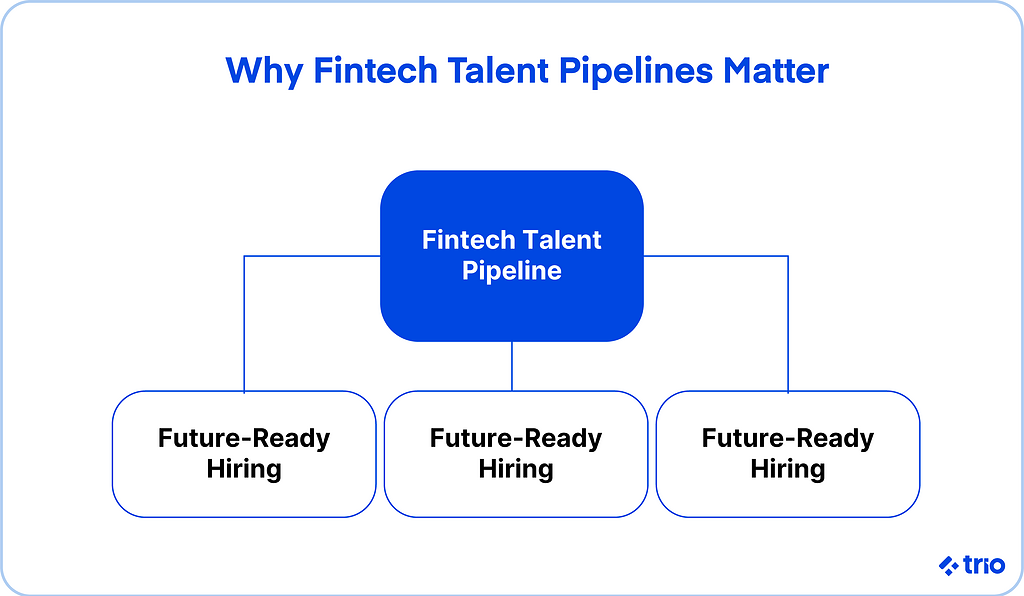
A strategic fintech talent pipeline gives you a pathway toward steady, future-ready hiring, along with the talent you need right now. It also helps you nurture and upskill teams in ways that better align with real industry needs.
Trio has spent years helping financial institutions build these pipelines, providing the skilled talent within as little as a couple of days, while retaining a large talent pool that allows you to scale up and down without additional waiting. Book a discovery call!
Key Takeaways
- Combining a talent pipeline with hiring models like staff augmentation gives you the freedom to scale up and down with minimal long-term risk.
- A fintech talent pipeline gives CTOs and team leads consistent access to the right talent for their fintech development.
- The battle for talent, combined with the niche skills required, has resulted in slow hiring cycles and made it difficult to both attract and retain top talent.
What a Fintech Talent Pipeline Is And Where Banks and Fintech Firms Often Struggle
A fintech talent pipeline is sometimes treated like a fancy term for recruitment.
In practice, it’s broader and more strategic. It covers everything from graduate outreach and early mentorship to internal upskilling, using techniques like fintech technology staff augmentation for mobility, and long-term retention.
Banks often hit obstacles because they rely on traditional hiring processes that feel slow and rigid when compared with how fintech companies operate. A fast-evolving environment requires a different mindset.
Roles shift quickly, skills become outdated, and the gap between expectations and reality widens unless the pipeline is built with intention.
It may sound simple on paper, but most organisations underestimate how much planning fintech talent acquisition actually requires.
Why Fintech Talent Pipelines Matter More Than Ever
A bank’s competitive edge used to grow out of scale and physical presence. These days, it has a lot more to do with the people writing your software, managing data integrity, and building reliable digital experiences.
Without a consistent way to attract and develop skilled professionals, it becomes difficult to launch new fintech roles or react quickly to market shifts.
A well-defined fintech talent pipeline helps you manage that complexity. This is even more true when you properly utilize financial technology staff augmentation.
With a reliable partner, you can access remote talent from all over the world and have a way to scale your team up and down using that skilled talent without needing to deal with the additional paperwork or hiring process involved with additional hires.
It turns hiring from a scramble into something predictable, and it gives your teams the breathing room to focus on the future of work rather than firefighting every open role.
Forces Reshaping Today’s Fintech Talent Landscape
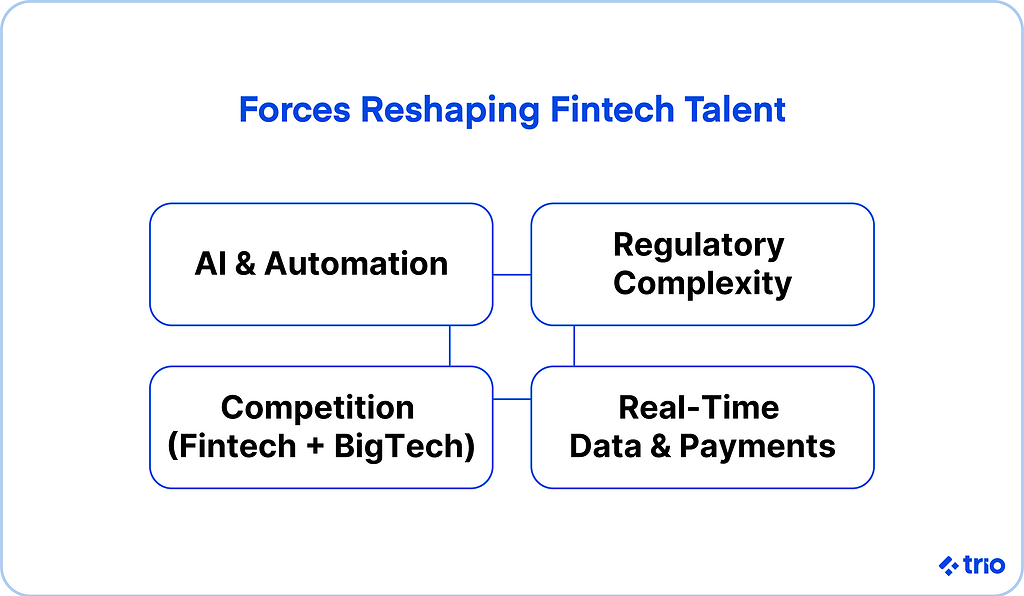
The fintech industry is being pulled in several directions at once.
Technology cycles accelerate while regulations become more intricate. Even experienced engineers find it tough to keep up with AI tools, blockchain architectures, and real-time analytics, and an increasing quality expectation for user interfaces.
Banks also face unusual competition. They are not just up against other established financial institutions. They are competing with fintech startups that offer flexible work and quicker decision cycles. As the leader of a fintech firm, you need to understand that you are now directly competing with these massive institutions for talent.
BigTech companies look attractive too, because they hand teams modern tools without legacy constraints. This wider battleground has changed what top talent requires from an employer.
These forces may seem overwhelming, but they also highlight why a better talent strategy is so important.
Modern Banking Viewed Through a Technology Lens
It almost feels like financial services underwent a quiet transformation.
Banks still carry the weight of licensing and compliance, but operationally, they function a lot like tech companies.
Most customer experiences depend on software. Even something like credit risk or fraud detection leans on heavy data analytics and automation.
This shift means fintech talent sits at the centre of your future success.
Engineers, product managers, data specialists, and compliance-aware developers help you stay ahead of market expectations. AT Trio, we have seen this play out repeatedly.
When organisations invest in forward-thinking talent early, their transformation work becomes smoother, and the whole organisation feels more stable.
Current Trends Shaping the Fintech Workforce
If you look at who is entering the fintech workforce today, you’ll notice how varied the backgrounds have become.
There are graduates from traditional programs, but also people coming through bootcamps, AI labs, and apprenticeships. Many learned by contributing to open-source projects or building their own tools.
Startups shape much of this culture. Their speed and customer-centric approach influence how engineers expect to work. If a bank wants to attract top talent, it often has to borrow from that mindset without losing sight of governance.
Technology trends also play a large part. AI, digital payments, blockchain, data analytics, and cybersecurity continue to drive demand.
Each one requires specialised skills that banks can’t simply buy on the open market forever, which is why building your own pathway to future talent needs is so important.
The Skills Banks and Large Fintechs Need
The list of required skills feels broader than it did just a few years ago.
Technical roles like cloud engineering and backend development are still central, but financial technology also demands people who understand compliance frameworks, customer experience, and risk.
Some organisations have begun focusing on transferable skills instead of rigid job descriptions.
A developer with strong problem-solving abilities can transition into API integrations or fraud systems with the right support. A product manager with years of experience in consumer apps might be a strong fit for digital onboarding.
This sort of flexibility may help bridge the gap between what the market can supply and what banks genuinely need.
Challenges Slowing Talent Pipeline Growth
A few issues tend to appear across most financial institutions.
The first is that the skills gap widens faster than training programs can address it. The second is that compliance often slows hiring decisions to a crawl. And the third is competition.
Engineers who understand AI, data modelling, or core banking platforms can pick from a global set of employers.
There is also a cultural layer to this. Some teams still work with outdated tooling or governance structures that make it difficult to keep top talent engaged. If your workforce feels blocked, retention naturally declines.
These are not simple problems, but acknowledging them openly helps you tackle them with better planning.
Related Reading: The Fastest Way to Hire Engineers for Fintech
Building a Strategic Fintech Talent Pipeline
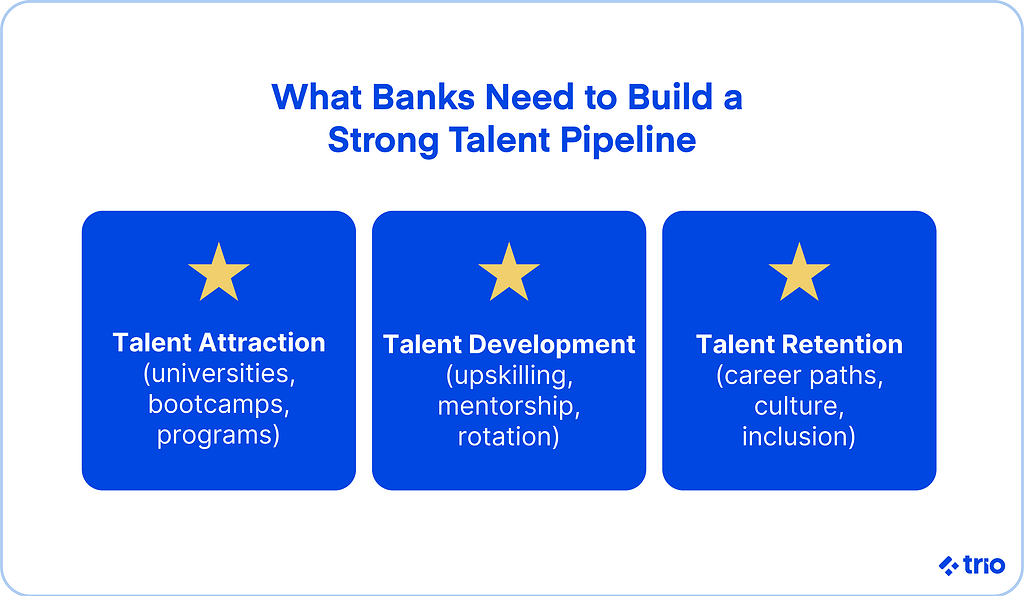
A stronger pipeline starts with people, not software. The most successful organisations invest early in partnerships with universities, bootcamps, and specialised training programs.
Some even collaborate with AI research groups or local workforce development initiatives to widen the pool of emerging talent.
Once people join your organisation, the focus shifts to retention and growth.
Engineers value clarity in their career path, trustworthy managers, and a culture where they can contribute meaningfully. Compensation matters, but so does the sense that their work has impact and that they can grow without leaving.
Diversity plays a real role, too. A workforce shaped by different geographic, socioeconomic, and neurodiverse backgrounds is usually better at solving the complicated problems that financial technology brings.
Inclusion genuinely strengthens your teams and encourages smarter problem-solving.
The Future of Fintech Talent
It seems likely that the next few years will reshape how financial institutions think about hiring. Automation will handle more low-level operational work.
AI copilots may support developers in ways that meaningfully speed up delivery. Digital payments, crypto infrastructure, and real-time data flows will introduce new types of fintech roles.
Training will change as well. Internal academies, rotating engineering programs, and skills-based hiring appear to be gaining traction.
These methods help organisations nurture talent at a time when external recruitment alone cannot meet demand for skilled professionals.
There is also growing interest in using data-driven tools to map skill gaps and forecast future talent needs. These systems aren’t perfect, but they may help teams make smarter decisions about what to prioritise.
Conclusion
Every bank knows the fintech industry is moving fast, but not everyone has a plan for how their workforce will evolve with it.
A strategic fintech talent pipeline gives you something much better than reactive hiring. It helps you nurture people who understand financial technology end-to-end, from core systems to AI to compliance.
When you invest in these pipelines, you create a more resilient organisation, one that can bridge the gap between immediate pressures and long-term transformation.
If you want support building this kind of pathway or you need help shaping a future-ready engineering team, Trio is ready to partner with you and bring years of experience to the table, as well as provide access to specialist fintech developers as part of your talent pipeline.
Request talent!
FAQs
What is a fintech talent pipeline?
A fintech talent pipeline is a structured pathway for attracting, developing, and retaining fintech talent, and a fintech talent pipeline helps larger financial institutions prepare for fast-changing technology and regulatory needs.
Why do banks and large financial companies need a strategic fintech talent pipeline?
Banks and large financial companies need a strategic fintech talent pipeline because the industry shifts quickly, and a strategic fintech talent pipeline ensures you can hire and grow the right people before gaps appear. Essentially, you are preparing ahead of time, with a staff augmentation partner like Trio, or on your own.
How do startups influence fintech talent expectations?
Startups influence fintech talent expectations because they work faster, and startups encourage engineers to expect autonomy and quicker decision cycles. Larger institutions need to understand that this is what talent then looks for, and if they cannot keep up, they may fall behind.
What skills are most important for fintech talent?
The skills most important for fintech talent include AI, data analytics, regulatory knowledge aligned with your product and region, and secure software development, and these skills help financial institutions keep pace with evolving systems.
How can banks and large financial institutions attract top fintech talent?
Banks and large financial institutions can attract top fintech talent by offering clear career growth and a strong engineering culture. On top of that, attracting top fintech talent also requires competitive pay and modern workflows.
Why is upskilling important in financial services?
Upskilling is important in financial services because technology changes faster than traditional training, and upskilling helps your workforce stay relevant and confident. This is especially true when it comes to regulatory and security standards.