

 Read Client Stories





 Alex Kugell

 Key Takeaways
- Owns architecture, stack, and hiring at the same time, and usually still writes code. That last part separates the job from an enterprise CTO.
- Hire a VP of Engineering instead when the hard problem is delivery throughput rather than technical direction.
- Average CTO salary runs about US$155,000 at seed, US$196,000 at Series A and US$238,000 at Series B, with hired CTOs taking 2 to 5 percent equity at seed and far less after that.
- A fractional or part-time CTO costs roughly US$5,000 to $15,000 a month, which is why pre-Series-A teams often start there.
- The architecture picked in month two decides who you can hire in month ten, so the first stack choice carries more weight than it looks.
- Security and compliance land on the CTO early in fintech, usually well before the first enterprise customer signs anything.
- What a startup CTO actually does,
- How their responsibilities change as your startup grows,
- Which skills and challenges define the role today, and
- When it’s time to hire or partner with one.
Startup CTOs rarely get the spotlight they deserve. While a chief executive officer (CEO) makes many of the high-stakes business decisions, it is often the chief technology officer (CTO) who informs those decisions and ensures the company’s product vision becomes reality.
For tech-oriented startups, including those in high-pressure sectors like fintech, the CTO is often a co-founder, strategist, and builder. In small, fast-moving teams, the CTO’s role can expand even further.
Startups rely on CTOs to guide both technical direction and product strategy, while also leading the engineering culture from the ground up.
With AI-driven development, cloud cost optimization, data privacy, and remote-first collaboration now central to success, a startup CTO must blend strategic insight with technical depth more than ever before.
To help you understand what this means for your own company, this article explores:
What a startup CTO actually does,
How their responsibilities change as your startup grows,
Which skills and challenges define the role today, and
When it’s time to hire or partner with one.
If you don’t have a CTO yet, Trio has spent nearly a decade connecting companies with senior developers and technical leads in niches like fintech, including people who cover most of what a startup CTO does at a lower cost than hiring one outright.
We focus on long-term tech partnerships with production-experienced developers, so they are invested in your company and the work that you do.
What Does a Startup CTO Do?
A startup CTO is the senior technical leader who owns the product’s architecture, picks the stack, and builds the engineering team, usually while still writing code themselves.
That last part is what separates the job from an enterprise CTO.
In a large company, the role sits above several layers of engineering management and is mostly organizational. In a startup, and especially in a heavily regulated industry like financial technology, the same person often ships the first version and then hires the people who will take it over from them.
What makes the job hard is that those three things move at once and constrain each other. The architecture you pick in month two decides who you can hire in month ten, and whoever you hire in month ten inherits that decision whether it was right or not.
In practice, the week rarely looks strategic. It tends to be a mix of code review, a hiring loop, one vendor decision nobody else can make, and an investor question about security that needs answering by Friday.
How the Role Has Evolved
Modern CTOs operate at the intersection of product, strategy, and innovation, managing everything from AI adoption and cloud efficiency to data security and team scalability.
As emerging technologies mature, the CTO is now responsible not just for building products but also for future-proofing the business through technical resilience and intelligent automation.
In fintech, this means that they are the person responsible for making sure you can adapt to shifting global regulations and user expectations.
CTOs as Strategic Partners
A strong CTO in a startup environment acts as a co-pilot to the CEO, translating the business vision into a technical roadmap. As we have already mentioned, they shape culture, define processes, and set the tone for how the team experiments, iterates, and grows.
The reality of growing and leading a startup is brutal. Nine out of ten startups fail.
There is a small margin for error, so you need to rely on strategic planning for growth and development.
When to Bring in a CTO
Hiring a CTO at the right stage can transform your startup’s trajectory. The best moment is often when:
Your technical challenges exceed what freelancers or agencies can handle,
You’re preparing to raise capital and need technical credibility, or
You’re scaling beyond an MVP and need systems that will last.
Startup CTO vs. VP of Engineering
We often see people use these two titles interchangeably, but they solve different problems.
Investor Fred Wilson has created a rough rule of thumb to follow: the CTO looks outward and forward, owning technology strategy, architecture, and the big platform bets, while the VP of Engineering looks inward and immediate, owning team structure, delivery cadence, and hiring.
The reality is that, very early, one person wears both hats. Once the team grows past ten to fifteen engineers, most startups split the roles, with the CTO staying focused on where the technology is heading and a VP of Engineering running how the team gets there.
So if what you really need is someone to run the engineering team and ship on schedule, you may want a VP of Engineering first.
How the Role Evolves by Stage
As your company grows, the CTO’s focus shifts from building to leading, and eventually to strategic scaling. Understanding this evolution helps you make smarter decisions about team structure, hiring, and where to spend your technical energy.
Below is a practical overview of how the CTO role typically changes through each stage of startup growth.
Early Stage (0–10 employees): Building the Foundation
In the beginning, the CTO is often a hands-on engineer and co-founder, turning ideas into a tangible product. They make fast, practical decisions and focus on getting the minimum viable product (MVP) to market.
Key priorities:
Choosing the tech stack and architecture for speed and simplicity.
Writing core code and managing version one releases.
Recruiting the first developers or freelancers.
Setting up essential workflows like source control, deployment, and QA.
Keeping costs low and delivery fast.
Growth Stage (10–50 employees): Building the Team and Process
Once your startup finds product–market fit, the CTO begins to step back from day-to-day coding and focus on leadership, systems, and stability.
Key priorities:
Hiring, mentoring, and retaining a capable development team.
Establishing development processes (Agile, Scrum, CI/CD).
Implementing reliable infrastructure and cloud cost control.
Introducing data governance, security, and compliance basics.
Translating the company roadmap into a clear technical strategy.
Expansion Stage (50+ employees): Leading Strategy and Innovation
At scale, the CTO’s role becomes predominantly strategic. The focus shifts from building features to ensuring the company’s technology strategy supports long-term goals.
Key priorities:
Aligning technical vision with business and investor expectations.
Overseeing architecture evolution and risk management.
Leading R&D and evaluating emerging technologies.
Partnering with other executives on company-wide strategy.
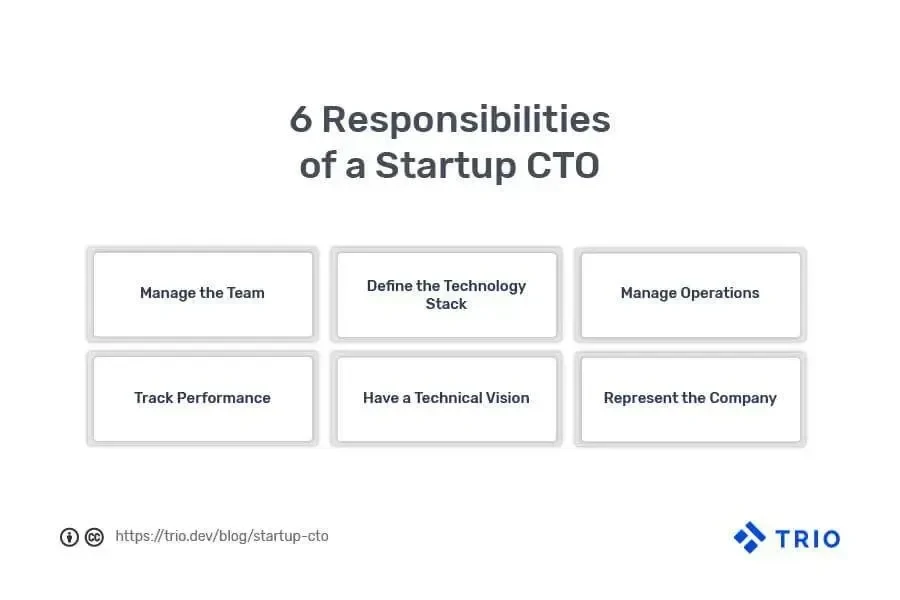
7 Responsibilities of a Startup CTO
At the expansion stage and beyond, the role of a startup CTO is more associated with rapid growth rather than long-term planning. But let’s focus on the seven principal responsibilities of a CTO that define the role and stay fairly consistent.
1. Manage the Team
It’s hard to imagine a startup CTO who doesn’t work well with people. CTOs are responsible for hiring and managing teams of developers and helping them complete projects effectively.
The foundation of a successful startup is the quality of the people on a team, which means that it’s essential for a CTO to be involved in the hiring process. They should understand what particular skills and capabilities the development team needs and how to identify these in potential hires.
With the right talent in place, a startup can build a great MVP, attract investors, and create a product that delights end-users.
2. Define the Technology Stack
A CTO provides the technical vision that guides the company’s architecture and stack decisions. This involves selecting the frameworks, languages, and tools that will help the team ship quickly while supporting future growth, automation pipelines, and scalable data systems.
3. Manage Operations
For a startup to operate effectively, it needs well-structured processes. A CTO shapes how the technical side of the company runs day-to-day.
They define the development methodology (Agile, Scrum, or Lean), establish deployment pipelines, and make sure progress is visible and measurable. A startup’s success often depends on how well these operations enable speed without sacrificing quality.
A CTO who understands operations ensures that the company is responsive, organized, and built for iteration.
4. Track Performance
Performance tracking goes beyond analytics. A strong CTO monitors not only the product’s metrics but also the team’s effectiveness.
They identify bottlenecks, celebrate achievements, and continuously refine workflows. This includes setting engineering KPIs such as lead time, deployment frequency, and system uptime.
A CTO should also create space for innovation, giving the team room to experiment without losing sight of delivery.
5. Have a Technical Vision
While the CEO defines the company’s overall mission, the CTO is responsible for turning that vision into a technical reality.
This involves crafting a clear technical strategy with measurable goals, risk assessments, and scalability plans. The CTO must anticipate future needs, make technology investments wisely, and ensure the team’s efforts align with long-term business objectives.
A great CTO blends technical mastery with business acumen, understanding not only how to build, but why.
6. Represent the Company
The CTO usually ends up as the person who explains the technology to people outside it: investors on a diligence call, a prospect’s security team, a reporter. In a tech startup that is promoting something genuinely new, it’s pretty much mandatory to have a qualified CTO to inspire trust in the product that they are building.
Funding opportunities often come from individuals and organizations like angel investors, venture capital firms, or accelerators. It comes as no surprise that these sources of capital scrutinize the leadership of a company, so representing the technical side well is part of the job.
Building relevance as a CTO is a well-rounded process that demands a fairly active involvement across the public spaces where the company has relevance.
7. Security & Compliance Oversight
With data privacy and cybersecurity now shaping how buyers and investors evaluate a startup, CTOs must take active responsibility for security architecture and compliance.
That means setting clear policies for data handling, access control, and encryption, as well as preparing for frameworks like GDPR, SOC 2, or ISO 27001. A CTO who prioritizes secure design early saves the company from costly retrofits later.
What Skills Should Startup CTOs Have?
So, how can a CTO make sure their skills are used properly in the startup environment? As mentioned before, the role can be dramatically different in a startup due to the lack of resources. With this in mind, let’s go over a few things to look for in a startup CTO.
A Customer-Centric Mindset
When developing a product or service, it’s vital to have a solid understanding of the specifications and plan the project around them.
The faster a CTO at a startup can understand exactly what problem they are trying to solve, and who they are trying to solve it for, the faster they can craft a customer-centric product or experience.
Team Management Skills
A startup can be described as an intimate experience for those involved. In the early days, teams are small and often confined to working physically close to one another. CTOs must be able to work closely with small teams and oversee their work.
Having a CTO with the ability to manage people effectively while teams scale up is very beneficial for a tech startup. This extends to hiring, setting goals, and, in some cases, firing staff.
Managing a team requires a leader who can connect with their team, identify their strengths and weaknesses, and apply them to the overarching vision of the company to make it a reality.
A company is nothing without the people behind it. A startup CTO should recognize this.
Prior Experience in Startups
The practices and culture found in a startup are quite different from those in larger companies.
Startups are more disruptive, fast-paced, and require working with limited resources without sacrificing quality. It can be a difficult adjustment for a professional who hasn’t experienced it before.
Understanding and being able to navigate the startup world is definitely a quality to look for in a CTO. From being able to secure funding for a venture to drawing on that network to grow the company, it pays off to have somebody familiar with the startup scene.
Negotiation Skills and Stakeholder Management
Besides leading technical projects, a CTO needs to communicate with the human resources department, executives at the company, stakeholders, and whoever else may have an interest in the development process.
Startup CTOs tend to be more invested in these interested parties than a CTO from a large company. They must negotiate with these parties to reach a compromise that serves the company.
Problem-Solving and Creativity Skills
A problem-solving mindset is about approaching every business and product challenge with a “systems thinking” perspective, breaking problems into manageable parts, and designing processes that prevent them from recurring.
Tech Skills
It goes without saying that a CTO should have strong technical depth. They may not write code every day, but they must understand the full software development lifecycle and make informed architectural decisions.
Key technical competencies include:
Data and security fundamentals for responsible growth.
Software design and architecture for scalability.
DevOps and cloud infrastructure management.
API and integration design for modular systems.
Strategic Thinking
A CTO’s impact is measured not only by what they build but by how their decisions shape the business.
Strategic thinking means looking beyond short-term features to long-term sustainability and ensuring the technology roadmap supports the goals of the company.
Governance and Communication
As startups mature, CTOs must handle heavier security, compliance, and governance demands. This requires translating technical realities into language that boards, investors, and non-technical executives can act on.
The ability to communicate risk, opportunity, and progress clearly is what transforms a capable technologist into a trusted leader.
Compensation and Equity Models for Startup CTOs
Attracting and retaining a capable CTO is one of the most strategic investments a startup can make. However, compensation for this role can vary dramatically depending on the company’s stage, funding, and structure.
Whether the CTO joins as a co-founder or a hired executive, the split between salary and equity is worth settling early. It decides how much runway the hire costs you, and how much of the upside they actually hold if things work.
How Compensation Evolves with Stage
CTO pay generally grows as a startup matures, though the spread at any one stage stays wide enough that an average makes a weak guide.
Kruze Consulting’s payroll data, drawn from several hundred VC-backed startups, puts the average CTO salary at US$155,000 at seed, US$196,000 at Series A and US$238,000 at Series B.
Published figures thin out past that point, and the later-stage numbers you tend to see quoted, often US$300,000 and up, come from executive search placements rather than payroll.
Founding CTOs frequently sit under all of those numbers, since many defer or take minimal pay while the product and the first round come together.
Equity moves the other way. A hired CTO joining at seed tends to land somewhere between 2 and 5 percent, closer to 1 to 3 percent at Series A, and 0.5 to 1.5 percent by Series B. A co-founding CTO sits in a different conversation entirely, usually 10 to 25 percent.
One option those ranges leave out is the fractional CTO, which many pre-Series-A startups lean on before committing to a full-time hire.
A fractional CTO bills a monthly retainer rather than a salary, commonly US$5,000 to $15,000 depending on how many days a week you need them.
How to Find and Hire a Startup CTO
Hiring the right CTO is one of the most critical steps in building a successful startup.
The ideal candidate combines deep technical knowledge with strong leadership and the ability to translate your vision into a product that can scale.
1. Define What You Need
Before you begin the search, take time to understand what your company truly needs from a CTO.
Early-stage startups often benefit from someone hands-on who can write code, design the architecture, and move quickly to validate the product.
Knowing this will help you attract candidates whose strengths align with your company’s current phase rather than what you hope to need later.
2. Source Candidates Strategically
Most great CTOs are not found through generic job postings but through focused outreach and trusted networks.
Start by reaching out within your personal, investor, and mentor circles, as referrals often produce the most qualified leads.
You can also look to professional networks such as LinkedIn or AngelList, where many experienced technical leaders are open to new opportunities.
3. Evaluate Beyond Technical Skills
When interviewing candidates, look beyond their technical accomplishments to understand how they think, communicate, and lead.
Ask them to share examples of how they have managed team growth, handled difficult trade-offs, and made decisions under pressure.
4. Consider a Fractional, Part-Time or Embedded CTO
If your startup is still validating its product or refining its roadmap, you may not yet need a full-time executive.
A fractional CTO can offer strategic direction, implement sound technical foundations, and guide your team through early development while keeping costs predictable.
As the company grows, this role can evolve into a permanent position or transition to in-house leadership.
The same arrangement goes by several names. You will see it advertised as a part-time CTO, a CTO consultant, CTO advisory, or CTO as a service, and the differences between those labels tend to be marketing rather than substance.
Cost sits well below a full-time hire. Most fractional CTOs charge somewhere between $5,000 and $15,000 a month for ten to twenty hours a week, and rate trackers put the hourly middle at roughly $150 to $250.
Arc draws the line differently, by how involved the work gets: closer to $5,000 to $12,000 for advisory help, and $15,000 to $30,000 once the person works hands-on in the codebase.
Where the arrangement stops working tends to be availability rather than skill. Someone in your Slack two days a week cannot sit in every hiring loop, cannot be the person a customer escalation reaches at 9 pm, and will struggle to carry an enterprise buyer’s security questionnaire through to signature.
Once those things start happening weekly, you have outgrown it.
Trio takes the search part off your hands.
We use our industry experience to help you figure out what the best person will look like for you, and we can connect you with vetted senior developers and technical leads who serve as fractional or embedded CTO partners in a couple of days, not weeks.
Top 3 Challenges of a Startup CTO
As you’ve seen here, the CTO’s role in a startup has many sides to it, each coming with its own set of challenges. These are some of the specific challenges that a CTO might face, especially in a startup environment.
1. Managing Talent
One common struggle in a startup is getting talent up to speed on startup projects.
Geography can sometimes be a limiting factor when hiring staff. Startup leadership has increasingly begun to hire remote workers as a solution. Though hiring remote comes with a unique set of challenges, it also allows for flexibility in how a team can be scaled.
Once talent has been obtained, retaining it is the next thing to worry about. There’s an endless sea of opportunities within the startup ecosystem.
There are also numerous ways to retain your startup talent. Oftentimes, it’s as simple as having an interesting product that truly makes them passionate about their work. Balancing an enjoyable work environment with sufficient benefits is key here.
2. Managing Innovation
Original thinking is the fuel for any successful startup. Whether a company will ‘make it or break it’ often boils down to whether something new is being brought to the table.
A startup can’t afford to think in three- or five-year cycles, as its limited runway means it needs to be able to produce new ideas quickly and be ready to pivot them whenever required.
The process of managing your company’s innovation is easier said than done. It comes down to creating a company-wide culture that promotes innovation for everybody involved.
For a CTO to be an effective leader at a startup, they need to actively encourage their team to bring forward new ideas to make the product they are building more groundbreaking.
3. Managing Priorities
Project management can be one of the hardest parts of developing software. There are many philosophies describing exact methods for overseeing development. But there is one thing that can consistently derail a project: feature creep.
This is when a development team continues to add more to their planned feature list until the project becomes impossible to actualize. When crafting and executing an ambitious idea, it’s difficult to balance a realistic product or service with an idealistic vision of one.
Good CTOs know how to prioritize what matters most for the company.
Conclusion
Startups revolve around an entrepreneurial mission to develop a unique product and an invested hope that it will perform well in the market. That said, more than hope is necessary to manifest a creative vision.
This is where CTOs come in. A CTO can manage the technical aspects of your company’s vision, bring an advantageous skill set, and be prepared to tackle the routine challenges involved in their duties.
Trio goes beyond providing exceptional software development insights; we connect you with the best Latin American developers in the fintech sector. Discover our elite Argentine developers, Chilean developers, and Brazilian developers for your outsourcing needs.
A good startup CTO earns their keep in the decisions nobody sees: the stack that does not have to be replaced at Series A, the security questionnaire that comes back clean, the senior engineer who says yes.